At almost every lighting exhibition we attend, someone eventually asks the same question.
“Isn’t tubular lighting just another type of linear lighting?”
At first glance, it is an understandable assumption. Both are elongated luminaires, both commonly use LED technology, and both can be suspended, surface-mounted or integrated into commercial buildings. In product catalogues, they are often grouped under the same “linear lighting” category, making the distinction even less obvious.
However, once the conversation moves beyond appearance, the differences become much more significant.
Over the past few years, we have worked with architects, lighting designers, electrical contractors and distributors across Europe, North America and the Middle East on a wide range of commercial and industrial projects. During project discussions, we have found that the final fixture selection is rarely determined by shape alone. Instead, it is influenced by factors such as environmental conditions, maintenance requirements, visual comfort, installation methods, ingress protection, impact resistance and long-term operating costs.
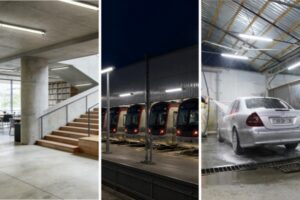
For example, an office renovation may prioritise seamless architectural aesthetics and low glare, while a food processing facility may require IP69K protection for daily high-pressure washdowns. A metro station may demand vandal-resistant construction and easy maintenance, whereas a boutique hotel may focus almost entirely on visual appearance and decorative integration.
These projects may all require linear illumination, yet they often lead to completely different fixture selections.
One of the biggest misconceptions we encounter is that tubular lighting and conventional linear lighting compete with each other. In reality, they were developed to solve different design challenges. Understanding those differences helps designers avoid specifying products based solely on appearance or price, reducing the likelihood of costly changes later in the project.
In this guide, we’ll compare tubular lighting and conventional linear lighting from an engineering and specification perspective, including:
- Structural design
- Optical performance
- Installation methods
- IP and IK protection
- Maintenance requirements
- Material selection
- Typical applications
- Long-term ownership cost
Rather than declaring one solution universally better, the goal is to explain where each type performs best and how to choose the right luminaire for different commercial environments.
New to tubular lighting?
Before continuing, we recommend reading our Ultimate Guide to Tubular Lighting, which explains the fundamentals, common applications, construction methods and terminology used throughout this article.
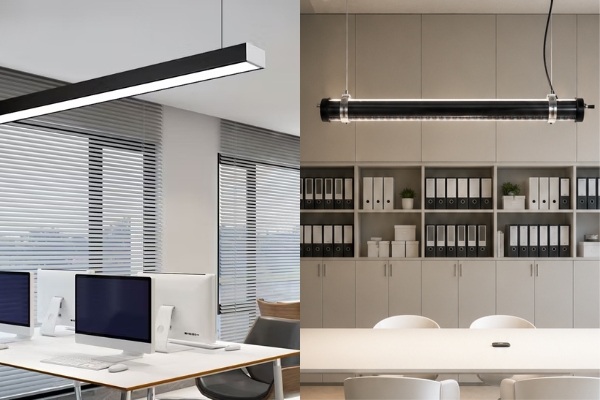
Why Are Tubular Lighting and Linear Lighting Often Confused?
The confusion is understandable because both lighting types belong to the broader family of linear luminaires. Both are designed to illuminate elongated spaces such as corridors, offices, supermarkets, retail stores, educational facilities and industrial buildings. Both are available in suspended, surface-mounted and wall-mounted configurations, and both commonly use integrated LED light engines instead of replaceable fluorescent lamps.
From a distance, their lighting effect can even appear similar. Both create continuous lines of light that visually elongate a space while providing uniform illumination over large areas.
However, similarity in appearance does not necessarily mean similarity in design.
Conventional linear luminaires evolved primarily from fluorescent batten fixtures, with rectangular housings designed to maximise manufacturing efficiency and simplify installation into suspended ceilings or trunking systems.
Tubular luminaires followed a different development path. Their cylindrical construction was originally adopted for environments where moisture, dust, impact resistance or frequent cleaning presented significant challenges. Over time, architects also recognised the visual simplicity of cylindrical fixtures, leading to widespread adoption in contemporary commercial, hospitality and public-space projects.
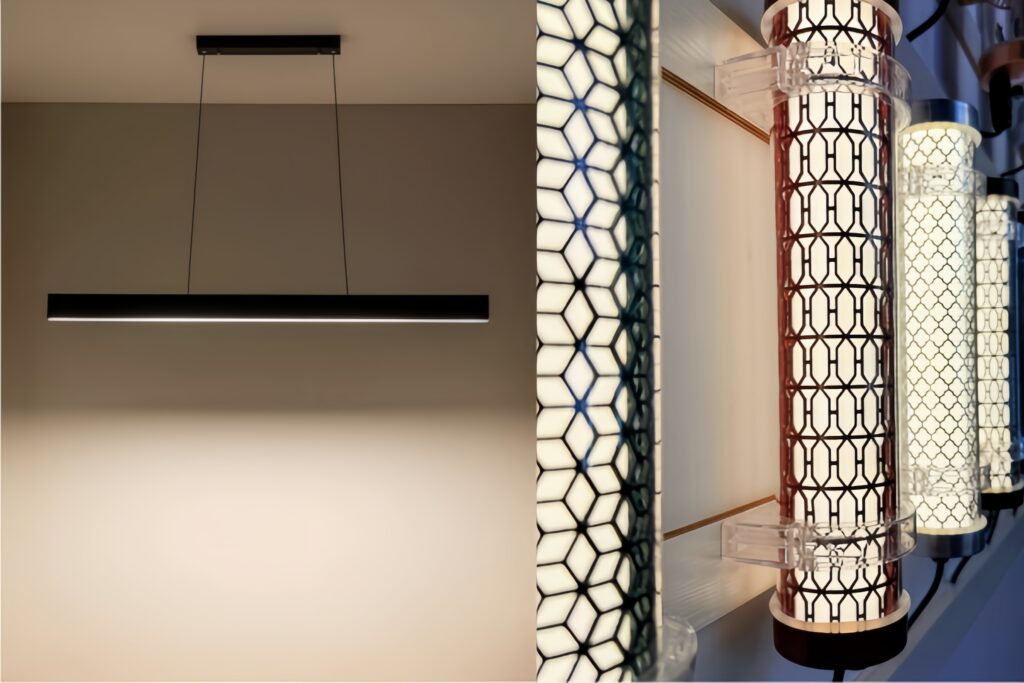
Today, tubular lighting is no longer limited to industrial environments. Decorative internal louvres, honeycomb optics, perforated diffusers, coloured inserts and custom finishes have transformed tubular luminaires into architectural lighting products while preserving their structural advantages.
This difference in design philosophy is the key reason why comparing these two fixture types requires more than simply looking at their shape.
Want to understand what tubular lighting actually is before comparing the two?
Read our complete guide:
What Is Conventional Linear Lighting?
Conventional linear lighting refers to luminaires with a rectangular or square-profile housing that distribute light primarily downward. They are among the most widely used lighting solutions in commercial buildings due to their versatility, cost-effectiveness and compatibility with suspended ceilings, trunking systems and continuous-row installations.
Modern linear luminaires are typically manufactured from extruded aluminium with polycarbonate or acrylic diffusers. Depending on the application, they may use opal diffusers for softer illumination, micro-prismatic optics for office environments or louvre systems to reduce glare.
Their greatest strengths are modularity and efficiency. Continuous linear systems can extend for dozens of metres with minimal visual interruption, making them particularly suitable for offices, retail stores, supermarkets and educational facilities where long, uninterrupted lines of light are required.
However, because many standard linear luminaires are designed primarily for indoor architectural environments, their protection ratings and mechanical robustness may be lower than those required for demanding industrial or outdoor applications.
This is where tubular luminaires begin to demonstrate their advantages.
Structural Design: Why Shape Is More Than Just Appearance
One of the biggest misconceptions in commercial lighting is that the difference between tubular lighting and conventional linear lighting is purely aesthetic.
In reality, the external shape reflects two fundamentally different engineering philosophies.
Traditional linear luminaires typically use an extruded aluminium housing with a flat diffuser, creating a rectangular profile that integrates neatly into suspended ceilings, recessed grids or continuous-row systems. This geometry maximises internal space for drivers, wiring and optical components while simplifying manufacturing and installation.
Tubular luminaires, by contrast, are built around a fully enclosed cylindrical housing. Instead of prioritising ceiling integration, the cylindrical form improves sealing performance, distributes mechanical stress more evenly and offers greater resistance to impact and environmental exposure. It also creates a softer visual profile that architects increasingly favour in exposed-ceiling designs.
In our experience, many customers initially choose between these two fixture types based on appearance. However, after reviewing the project environment, the deciding factors usually become waterproofing, maintenance requirements and long-term durability rather than aesthetics alone.
Optical Performance: Light Distribution Matters More Than Fixture Shape
Many buyers compare luminaires using only lumen output or efficacy.
While these specifications are important, they rarely determine how a space actually feels after installation.
The optical system—including the emitting surface, diffuser material and beam control—has a far greater influence on visual comfort than total lumen output alone.
Conventional linear luminaires generally emit light through a flat downward-facing diffuser, concentrating illumination onto the working plane below. This makes them highly efficient for offices, classrooms and retail environments where horizontal illuminance is the primary design objective.
Tubular luminaires, however, can be engineered with several different optical configurations.
Depending on the application, they may provide:
- 120° directional distribution
- 180° semi-cylindrical distribution
- Full 360° omnidirectional illumination
- Narrow beam optics for feature lighting
- Decorative louvre or honeycomb optics for glare control
This flexibility allows tubular luminaires to perform equally well in industrial facilities requiring high vertical illumination and in architectural spaces where visual appearance is just as important as photometric performance.
Rather than asking which fixture produces more light, lighting designers usually ask a different question:
“Where do I want the light to go?”
That question determines the most appropriate optical system.
Installation Flexibility
Installation is another area where these two lighting systems begin to diverge.
Linear luminaires were originally developed to replace fluorescent battens and therefore integrate naturally with suspended ceilings, recessed grids and continuous-row trunking systems.
In office buildings, this approach offers excellent installation efficiency, especially when hundreds of fixtures are connected in long uninterrupted lines.
Tubular luminaires are generally more versatile in exposed architectural environments.
Depending on the project, they can be supplied as:
- Suspended pendants
- Surface-mounted fixtures
- Wall-mounted luminaires
- Vertical feature lighting
- Corner-mounted installations
- Linkable continuous systems
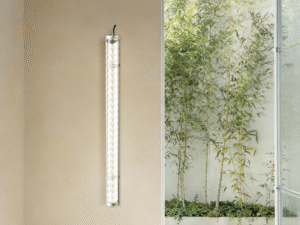
Because the cylindrical housing appears visually balanced from every viewing angle, tubular luminaires often become a design element rather than simply a source of illumination.
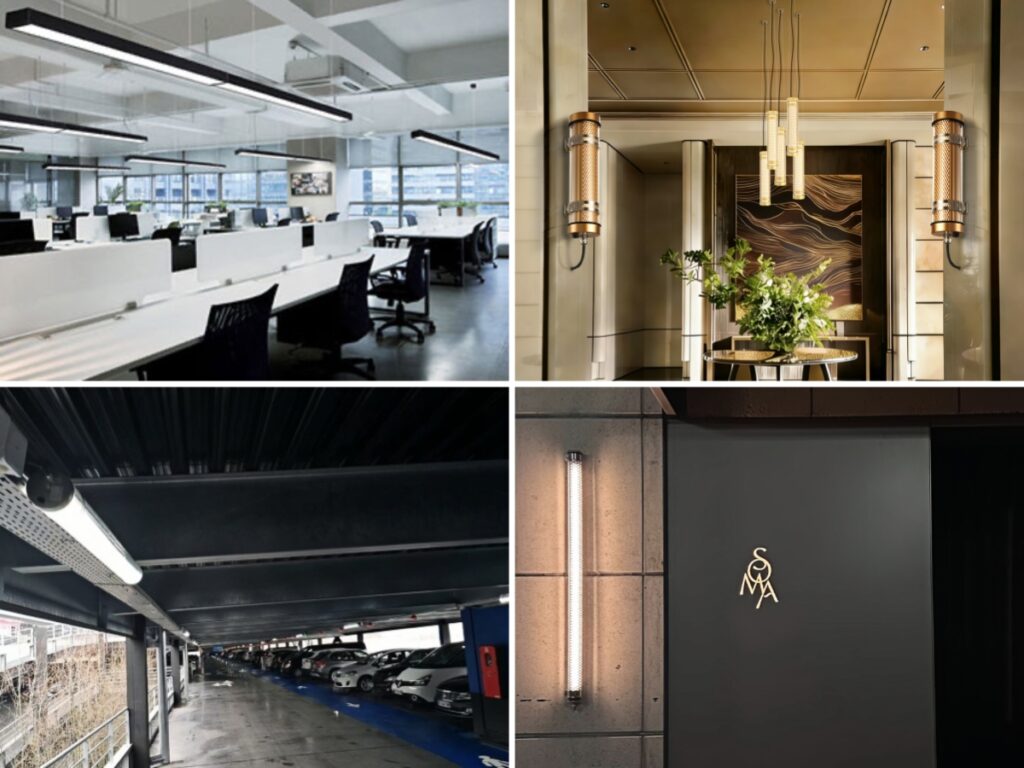
This is one reason why architects increasingly specify tubular lighting in hotel lobbies, restaurants, galleries and contemporary office interiors where the fixtures remain visible.
Durability and Environmental Protection
Perhaps the most significant difference between tubular and conventional linear lighting lies in environmental protection.
Many standard linear luminaires are designed primarily for indoor commercial environments. They typically provide sufficient protection for offices, classrooms and retail stores, where dust, moisture and mechanical impact are relatively limited.
Tubular luminaires were originally developed for much harsher operating conditions.
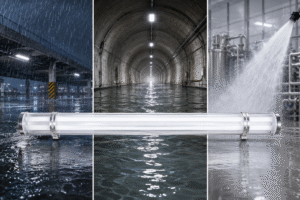
The cylindrical enclosure naturally lends itself to more reliable sealing, allowing manufacturers to achieve protection ratings such as IP67, IP68 and even IP69K when combined with appropriate sealing systems.
Likewise, impact resistance can be significantly improved through the use of thick-wall polycarbonate housings, stainless steel mounting clips and reinforced end caps, making IK10 performance achievable for demanding public and industrial environments.
In practice, this means tubular luminaires are often selected for applications involving:
- Food processing facilities
- Car washes
- Metro stations
- Underground tunnels
- Parking garages
- Industrial plants
- Livestock buildings
- Coastal environments with corrosive atmospheres
These are applications where long-term reliability is often more valuable than achieving the highest initial luminous efficacy.
Interested in ingress protection ratings?
Read our detailed guide:
IP65 vs IP67 vs IP69K Tubular Lighting
| Comparison | Tubular Lighting | Conventional Linear Lighting |
|---|---|---|
| Housing Shape | Cylindrical enclosed housing | Rectangular aluminium profile |
| Optical Options | 120°, 180°, 360°, lenses, louvers, honeycomb | Mainly downward distribution |
| Installation | Suspended, surface, wall, vertical, continuous | Mainly suspended, recessed or surface |
| Waterproof Performance | Up to IP69K | Typically IP20–IP65 |
| Impact Resistance | Up to IK10 | Typically IK06–IK08 |
| Suitable Environment | Architectural and harsh industrial applications | Mainly indoor commercial environments |
| Architectural Appearance | Excellent | Good |
Choosing the Right Luminaire for Different Commercial Applications
Although tubular lighting and conventional linear lighting can both deliver high-quality LED illumination, they are not intended to solve the same design problems.
Over the years, we’ve noticed that projects rarely fail because the wrong lumen package was selected. Instead, they fail because the fixture wasn’t designed for the environment it was installed in.
For example, we’ve seen waterproof luminaires unnecessarily specified for dry office spaces, increasing project costs without adding meaningful value. Conversely, we’ve also encountered standard indoor linear fixtures installed in humid industrial facilities, only to require premature replacement due to moisture ingress, corrosion or mechanical damage.
The best luminaire is not necessarily the most advanced one—it’s the one that best matches the environment, maintenance strategy and design objectives.
The table below summarises our typical recommendations based on different commercial applications.
Application Selection Guide
| Application | Recommended Solution | Reason |
|---|---|---|
| Corporate Offices | Linear Lighting | Continuous rows, excellent ceiling integration and high visual comfort. |
| Open Ceiling Offices | Tubular Lighting | Architectural appearance with exposed installation. |
| Hotels & Hospitality | Tubular Lighting | Decorative design with customizable finishes and optics. |
| Retail Stores | Either | Depends on architectural concept and lighting design. |
| Museums & Galleries | Tubular Lighting | Better aesthetic integration and optional beam control. |
| Food Processing Plants | Tubular Lighting | IP69K washdown capability and hygienic enclosed design. |
| Parking Garages | Tubular Lighting | High impact resistance and moisture protection. |
| Metro & Railway Stations | Tubular Lighting | Excellent vandal resistance and long service life. |
| Schools & Universities | Linear Lighting | Economical for standard classrooms. |
| Industrial Warehouses | Depends on Environment | Dry areas may use linear fixtures; humid or dusty areas benefit from tubular luminaires. |
Total Cost of Ownership: Looking Beyond the Purchase Price
When comparing quotations, it’s tempting to focus on the fixture price alone.
However, experienced contractors and facility managers know that the purchase price represents only a fraction of the total investment.
The real cost of a lighting system includes:
- Installation labour
- Cleaning requirements
- Replacement frequency
- Maintenance access
- Downtime
- Energy consumption
- Spare parts availability
In projects where fixtures are installed six or eight metres above the floor, replacing a failed luminaire may require lifts, traffic control or production shutdowns. In these situations, reducing maintenance often delivers greater long-term savings than choosing the lowest initial purchase price.
This is one reason why tubular luminaires are commonly specified in transportation infrastructure, manufacturing facilities and public buildings where maintenance interruptions are expensive.
On the other hand, in standard office environments with accessible ceilings and relatively clean conditions, conventional linear lighting often provides the most economical solution throughout its service life.
Considering the total cost of ownership (TCO) rather than the initial fixture price usually leads to more informed procurement decisions.
When We Recommend Tubular Lighting
Based on our experience working on commercial and industrial projects, tubular lighting is often the preferred choice when the project involves one or more of the following requirements:
- High humidity or frequent washdown
- Outdoor or semi-outdoor installation
- High IP or IK ratings
- Exposed architectural ceilings
- Corrosive environments
- Long maintenance intervals
- Decorative lighting combined with durability
- Custom finishes, lengths or internal decorative structures
- Vandal-resistant public infrastructure
Many modern tubular luminaires also offer decorative options such as internal louvres, perforated metal inserts, honeycomb optics and coloured reflectors, allowing designers to combine architectural aesthetics with industrial-grade performance.
Interested in where tubular lighting performs best?
Read:
- Tubular Lighting for Parking Garages
- Tubular Lighting for Metro Stations
- Tubular Lighting for Poultry Farms
- Tubular Lighting for Industrial Facilities
- Tubular Lighting for Residential Communities
- Tubular Lighting for Office Buildings
- Tubular Lighting for Hotels & Restaurants
- Tubular Lighting for Outdoor Areas
- Tubular Lighting for Retail Stores
When Conventional Linear Lighting Is Still the Better Choice
Despite the growing popularity of tubular luminaires, conventional linear lighting remains an excellent solution for many projects.
We typically recommend linear lighting when:
- The project uses modular suspended ceilings
- Continuous-row lighting is required over long distances
- Budget is the primary consideration
- Environmental protection requirements are relatively low
- Fast installation is prioritised
- Fixtures will remain largely hidden within the ceiling design
Choosing linear lighting in these situations is not a compromise—it’s often the most practical and cost-effective engineering decision.
The goal should never be to specify tubular lighting for every project. Instead, the objective is to match the luminaire to the operational requirements, architectural intent and maintenance strategy of the building.
Our Recommendation
Rather than asking:
“Which lighting technology is better?”
we encourage designers to ask a different question:
“Which lighting solution best supports the long-term performance of this project?”
In many architectural interiors, conventional linear lighting continues to be the ideal choice because of its simplicity and seamless ceiling integration.
For projects where durability, environmental protection, architectural expression or reduced maintenance are priorities, tubular lighting often delivers greater long-term value despite a higher initial investment.
Ultimately, successful lighting specification is not about selecting the newest product—it’s about selecting the right product for the environment in which it will operate.
A Practical Specification Checklist Before You Make a Decision
If you’re still deciding between tubular lighting and conventional linear lighting, don’t start by comparing product catalogues.
Instead, start by asking a few practical questions about the project itself.
1. What is the installation environment?
Is the fixture installed in a clean office, a humid parking garage, a food processing facility or an outdoor canopy?
The harsher the environment, the more important factors like IP rating, impact resistance and corrosion protection become.
2. Will the luminaire remain visible?
If the fixture becomes part of the architectural design, appearance matters just as much as performance.
Modern tubular luminaires offer a wide range of decorative options, including coloured finishes, internal louvres, honeycomb optics and perforated metal inserts, making them suitable for hospitality, retail and public spaces where lighting contributes to the overall visual identity.
3. How difficult will future maintenance be?
Replacing a luminaire in a warehouse with a 10-metre ceiling is very different from replacing one in a small office.
If maintenance requires lifts, traffic management or production shutdowns, investing in a more durable fixture often reduces lifetime operating costs.
4. Does the project require customisation?
Many architectural projects require more than a standard catalogue product.
Typical customisation options include:
- Custom lengths
- Special RAL colours
- DALI or Casambi controls
- Emergency lighting
- Decorative internal structures
- Custom beam angles
- Stainless steel hardware
- Higher corrosion resistance
Choosing a manufacturer capable of engineering these modifications can simplify the specification process considerably.
5. What is the client’s long-term expectation?
Some projects prioritise the lowest purchase price.
Others prioritise aesthetics.
Others focus on reducing maintenance over the next fifteen years.
Understanding which objective matters most usually leads to a much better fixture selection than comparing wattage or lumen output alone.
Final Thoughts
Tubular lighting and conventional linear lighting are often presented as competing products, but that comparison is somewhat misleading.
Both belong to the broader family of linear luminaires, yet they were developed to solve different engineering and architectural challenges.
Conventional linear lighting remains one of the most efficient solutions for offices, educational facilities and commercial interiors where continuous rows, ceiling integration and cost-effectiveness are the primary design goals.
Tubular lighting, on the other hand, extends the possibilities of linear illumination into environments where durability, environmental protection and architectural expression are equally important. Its enclosed cylindrical construction, flexible optical options and robust mechanical performance make it particularly suitable for hospitality, transportation, industrial facilities and exposed architectural spaces.
In our experience, the most successful lighting projects rarely begin by asking, “Which fixture is better?”
Instead, they begin with a different question:
“What does this environment actually require?”
Once that question is answered, selecting the right luminaire becomes much more straightforward.
Whether you choose tubular lighting or conventional linear lighting, the best specification is always the one that balances performance, maintenance, aesthetics and long-term value for the specific application.
Continue Reading
If you found this comparison helpful, you may also be interested in the following guides:
- Ultimate Guide to Tubular Lighting
- What Is Tubular Lighting?
- Where Is Tubular Lighting Used?
- How to Choose Tubular Lighting for Commercial Projects
- PC vs PMMA vs Borosilicate Glass: Which Housing Material Is Best?
- IP65 vs IP67 vs IP69K: What’s the Difference?