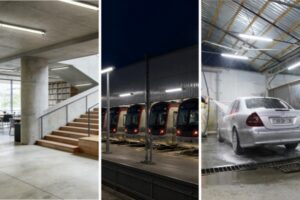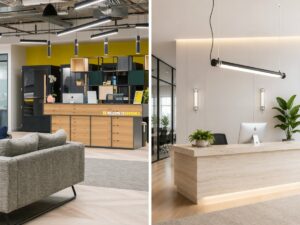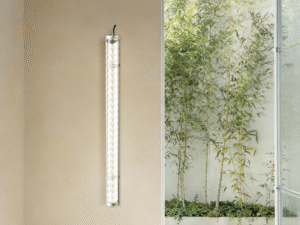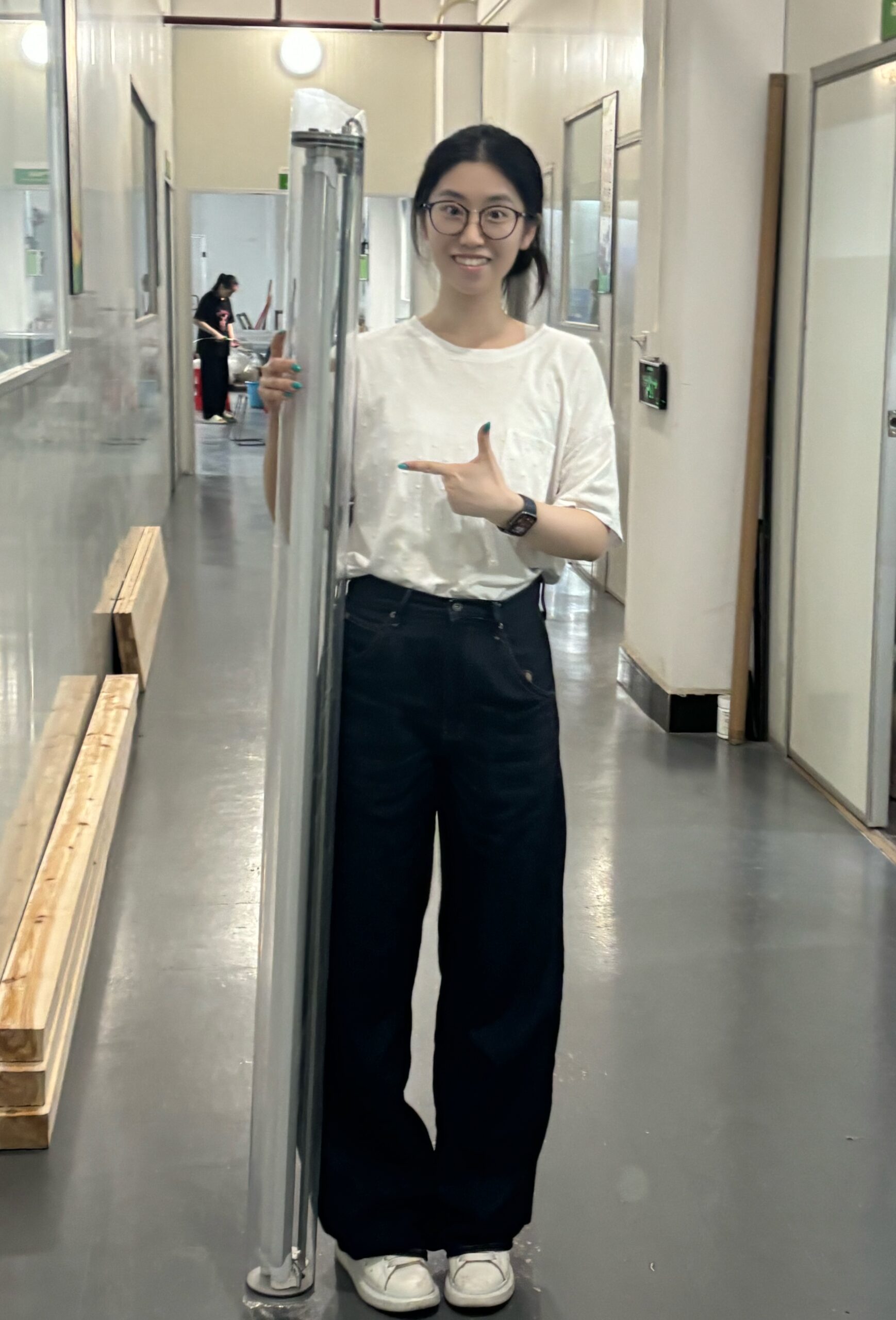
When specifying tubular lighting for a commercial or industrial project, one specification appears on almost every datasheet: the IP rating.
Many buyers naturally assume that a higher IP number always means a better luminaire. In reality, that’s one of the most common misconceptions in professional lighting.
A parking garage, a food processing facility, a metro tunnel and a pharmaceutical cleanroom may all require waterproof luminaires, yet they often need different levels of environmental protection. Installing an IP69K fixture where an IP65 luminaire would be perfectly adequate increases project costs without providing meaningful benefits. On the other hand, choosing an IP65 luminaire for a facility that is cleaned daily with high-pressure hot water can significantly shorten the fixture’s service life.
The challenge is that IP ratings describe different types of protection—not simply stronger or weaker waterproof performance. Understanding how these ratings are tested is far more useful than simply comparing the numbers.
In this guide, we’ll explain the real differences between IP65, IP67 and IP69K tubular lighting, discuss where each protection level is most appropriate, and provide practical selection advice for architects, lighting designers, contractors and procurement teams.
Whether you’re specifying luminaires for a warehouse, tunnel, parking garage, food factory or heavy industrial facility, this guide will help you choose the right protection rating without overspending—or under-specifying your project.
Learn more about the fundamentals of tubular luminaires in our What Is Tubular Lighting? guide before comparing protection ratings.
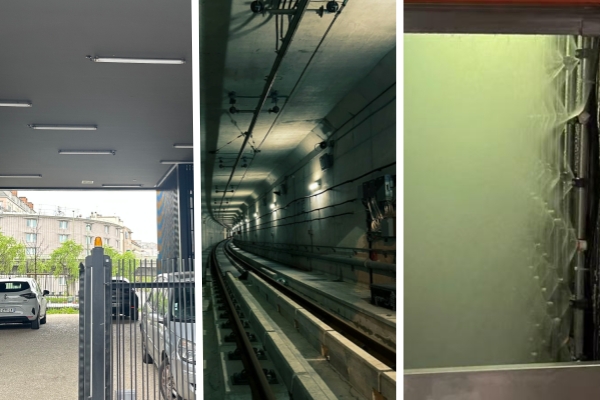
What Does an IP Rating Actually Mean?
Before comparing IP65, IP67 and IP69K, it’s important to understand what an IP rating actually measures.
IP stands for Ingress Protection, an international classification defined by IEC 60529. It indicates how well an enclosure prevents solid particles and liquids from entering electrical equipment.
An IP rating consists of two numbers:
- The first digit indicates protection against solid objects such as dust.
- The second digit indicates protection against water under specific test conditions.
For tubular lighting, the first digit is almost always 6, meaning the enclosure is completely dust-tight. The real differences lie in the second digit, which determines how the luminaire performs when exposed to rain, water jets, immersion or high-pressure cleaning.
It is also important to understand that IP ratings are based on standardized laboratory tests. They do not automatically guarantee long-term reliability in every real-world environment. Factors such as sealing materials, enclosure design, UV exposure, chemical resistance and installation quality all influence how well a luminaire performs over its lifetime.
| IP Rating | Dust Protection | Water Protection | Typical Applications |
|---|---|---|---|
| IP65 | Completely dust-tight | Protected against water jets from any direction | Parking garages, warehouses, outdoor walkways |
| IP67 | Completely dust-tight | Protected during temporary immersion in water | Tunnels, flood-prone areas, wastewater facilities |
| IP68 | Completely dust-tight | Protected during continuous immersion (manufacturer specified) | Special underwater lighting applications |
| IP69K | Completely dust-tight | Protected against high-pressure, high-temperature water jets | Food processing, pharmaceutical plants, car washes |
Why IP69K Is Not Simply “Better” Than IP67
One of the biggest misconceptions in commercial lighting is believing that IP69K is simply a higher version of IP67.
It isn’t.
Although both ratings indicate excellent environmental protection, they evaluate completely different test conditions.
An IP67 luminaire is designed to withstand temporary immersion in water, making it suitable for environments where flooding or standing water may occasionally occur.
An IP69K luminaire, however, is tested against high-pressure, high-temperature water jets delivered from multiple directions. This rating is intended for equipment that undergoes frequent washdown procedures, particularly in hygienic industries such as food processing, beverage production and pharmaceutical manufacturing.
Interestingly, an IP69K test does not include immersion testing, while an IP67 test does not evaluate resistance to high-pressure cleaning.
This distinction is why engineers choose different protection ratings depending on how the luminaire will actually be exposed to water—not simply by selecting the highest number available.
For example:
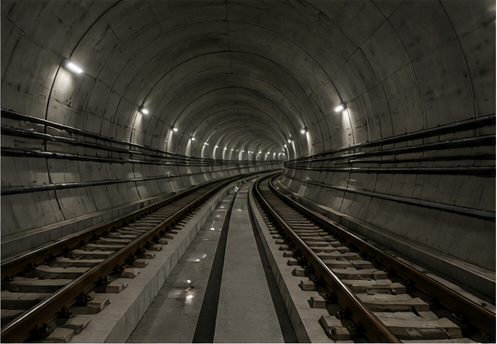
- A metro tunnel that may occasionally flood is typically a good candidate for IP67 tubular lighting.
- A meat processing facility cleaned every day with hot, high-pressure water usually requires IP69K luminaires.
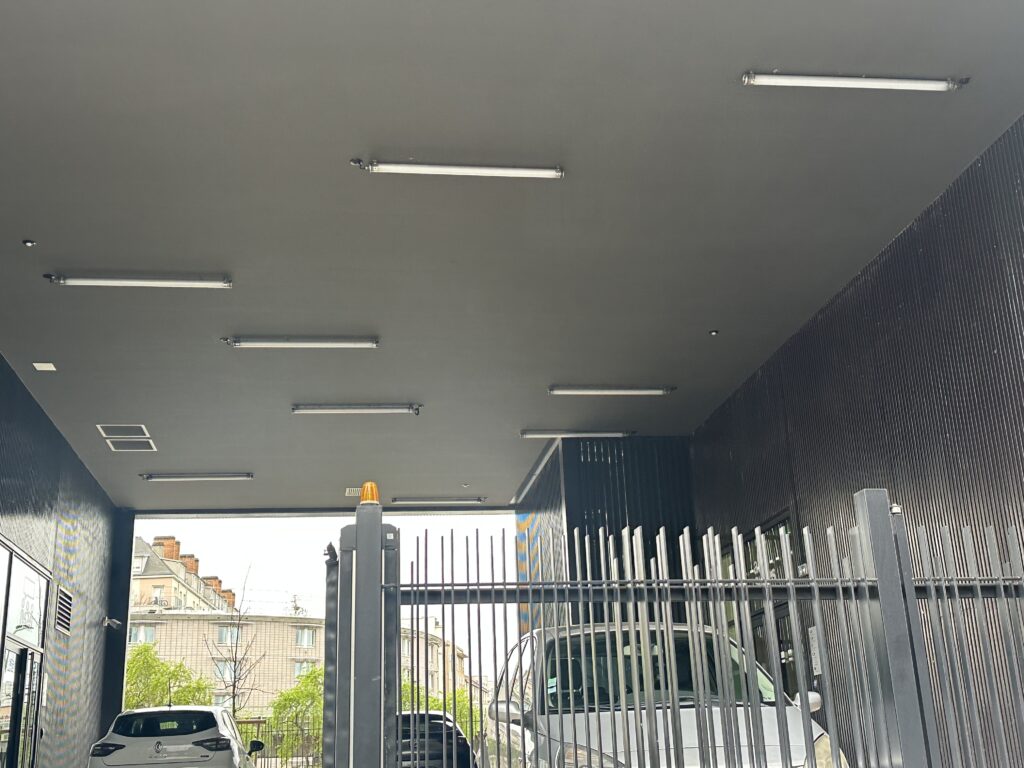
- An outdoor parking garage exposed only to rain and occasional hose cleaning is often well served by IP65.
Selecting the correct IP rating is therefore about matching the protection level to the environmental risks, rather than buying the highest specification available.
If you’re still comparing tubular luminaires with traditional fixtures, read our Tubular Lighting vs Linear Lighting guide to understand how enclosure design also influences long-term durability.
IP65 Tubular Lighting: Ideal for Everyday Commercial and Outdoor Applications
For many commercial projects, IP65 is the most practical balance between environmental protection and project cost.
An IP65 tubular luminaire is completely protected against dust ingress and can withstand low-pressure water jets from any direction. This makes it suitable for environments where fixtures are exposed to rain, splashing water or routine cleaning, but not prolonged immersion or high-pressure washdown.
Contrary to popular belief, most outdoor lighting projects do not require IP67 or IP69K protection. Specifying a higher IP rating than the environment demands often increases project costs without improving reliability.
Typical applications for IP65 tubular lighting include:
- Covered parking garages
- Warehouse aisles
- Outdoor walkways
- Loading docks
- Bus shelters
- Building facades
- School campuses
- Logistics centers
These environments generally expose luminaires to dust, humidity and occasional hose cleaning, but not flooding or intensive sanitation procedures.
Another advantage of IP65 luminaires is that they often offer simpler construction and lower manufacturing costs than IP69K products. When correctly specified, they can provide many years of reliable operation without unnecessary overengineering.
That said, designers should avoid using IP65 fixtures in locations where standing water, frequent condensation or high-pressure cleaning is expected. In these situations, choosing IP67 or IP69K from the outset is usually more economical than replacing failed luminaires later.
IP67 Tubular Lighting: Designed for Flooding, Condensation and Harsh Outdoor Conditions
Although IP65 is sufficient for many commercial buildings, some environments expose luminaires to a completely different type of risk.
Instead of rain or occasional washing, these projects face temporary flooding, persistent moisture or severe condensation.
This is where IP67 tubular lighting becomes the preferred choice.
An IP67 luminaire is tested to withstand temporary immersion in water, making it suitable for environments where water may accumulate unexpectedly. Examples include underground infrastructure, coastal installations and facilities where drainage problems occasionally occur.
Unlike IP65 fixtures, which are evaluated using water jet testing, IP67 luminaires are designed to maintain enclosure integrity even when completely submerged for a limited period under standardized laboratory conditions.
Typical applications include:
- Metro and railway tunnels
- Underground parking structures
- Coastal infrastructure
- Wastewater treatment plants
- Poultry and livestock facilities
- Outdoor industrial sites
- Flood-prone warehouses
- Cold storage facilities with heavy condensation
These environments often experience significant humidity fluctuations. Moisture can enter poorly sealed luminaires through repeated thermal expansion and contraction, eventually leading to corrosion, optical degradation and driver failure.
For this reason, many premium IP67 tubular luminaires incorporate features beyond the minimum testing requirements, such as:
- Multiple silicone sealing gaskets
- Pressure-balanced enclosure design
- Corrosion-resistant stainless steel hardware
- UV-stabilized diffuser materials
- Waterproof cable glands and connectors
These design elements help maintain long-term sealing performance even after years of exposure to changing environmental conditions.
It is worth noting that IP67 does not mean the luminaire is suitable for high-pressure cleaning. This misunderstanding frequently leads to premature failures in food processing facilities and industrial plants where washdown procedures are performed daily.
IP69K Tubular Lighting: Built for High-Pressure Hygienic Washdown
IP69K represents a fundamentally different approach to environmental protection.
Rather than focusing on immersion, IP69K evaluates a luminaire’s ability to withstand repeated cleaning using high-pressure, high-temperature water jets.
This protection level was originally developed for industries where equipment must be sanitized frequently to maintain strict hygiene standards.
Typical examples include:
- Food processing factories
- Beverage production plants
- Dairy facilities
- Meat processing plants
- Pharmaceutical manufacturing
- Commercial kitchens
- Car wash facilities
- Chemical processing plants
During routine cleaning, luminaires may be exposed to water temperatures approaching 80°C, delivered at high pressure from multiple directions.
These conditions place enormous stress on sealing systems, enclosure materials and cable entries. A luminaire designed only for rain or temporary immersion may gradually lose its sealing performance under repeated washdown cycles.
For this reason, high-quality IP69K tubular luminaires are usually engineered with:
- Precision-machined sealing interfaces
- High-grade silicone gaskets
- 316L stainless steel end caps and fasteners
- Corrosion-resistant mounting brackets
- Smooth housing profiles that minimize dirt accumulation
- High-quality cable glands capable of maintaining seal integrity under repeated cleaning
The goal is not simply to prevent water ingress during one laboratory test, but to maintain consistent protection after thousands of cleaning cycles throughout the luminaire’s service life.
This is why IP69K products generally carry a higher purchase price than IP65 or IP67 alternatives. The additional cost reflects more sophisticated engineering, higher-grade materials and tighter manufacturing tolerances—not merely a different certification label.
| Feature | IP65 | IP67 | IP69K |
|---|---|---|---|
| Dust Protection | ★★★★★ | ★★★★★ | ★★★★★ |
| Rain Exposure | Excellent | Excellent | Excellent |
| Water Jets | Yes | Yes | High-pressure washdown |
| Temporary Immersion | No | Yes | Not covered by IP69K test |
| High-pressure Cleaning | No | No | Yes |
| Typical Industries | Commercial buildings | Infrastructure & outdoor industry | Food & pharmaceutical |
| Relative Cost | Lowest | Medium | Highest |
Expert InsightWhen specifying tubular lighting, don’t ask “Which IP rating is the highest?” Instead, ask “What kind of water exposure will this luminaire actually face?”
A warehouse exposed to occasional rain, a tunnel that may experience temporary flooding and a food factory that undergoes daily high-pressure cleaning all require different protection strategies.
Selecting the appropriate IP rating not only improves long-term reliability but also helps optimize the total cost of ownership by avoiding unnecessary overspecification or premature replacement.
How to Choose the Right IP Rating for Your Project
When selecting tubular lighting, many buyers immediately ask:
“Which IP rating should I choose?”
A better question is:
“What kind of environmental exposure will this luminaire experience throughout its service life?”
The answer depends on much more than whether the fixture is installed indoors or outdoors.
Consider the following factors before selecting an IP rating:
- Will the fixture only be exposed to rain?
- Is temporary flooding possible?
- Will operators clean the fixture using high-pressure water?
- Are detergents or chemicals used during cleaning?
- Will condensation occur daily?
- Is corrosion a concern due to coastal or chemical environments?
By answering these questions first, you can often eliminate unnecessary specifications while ensuring the luminaire delivers reliable long-term performance.
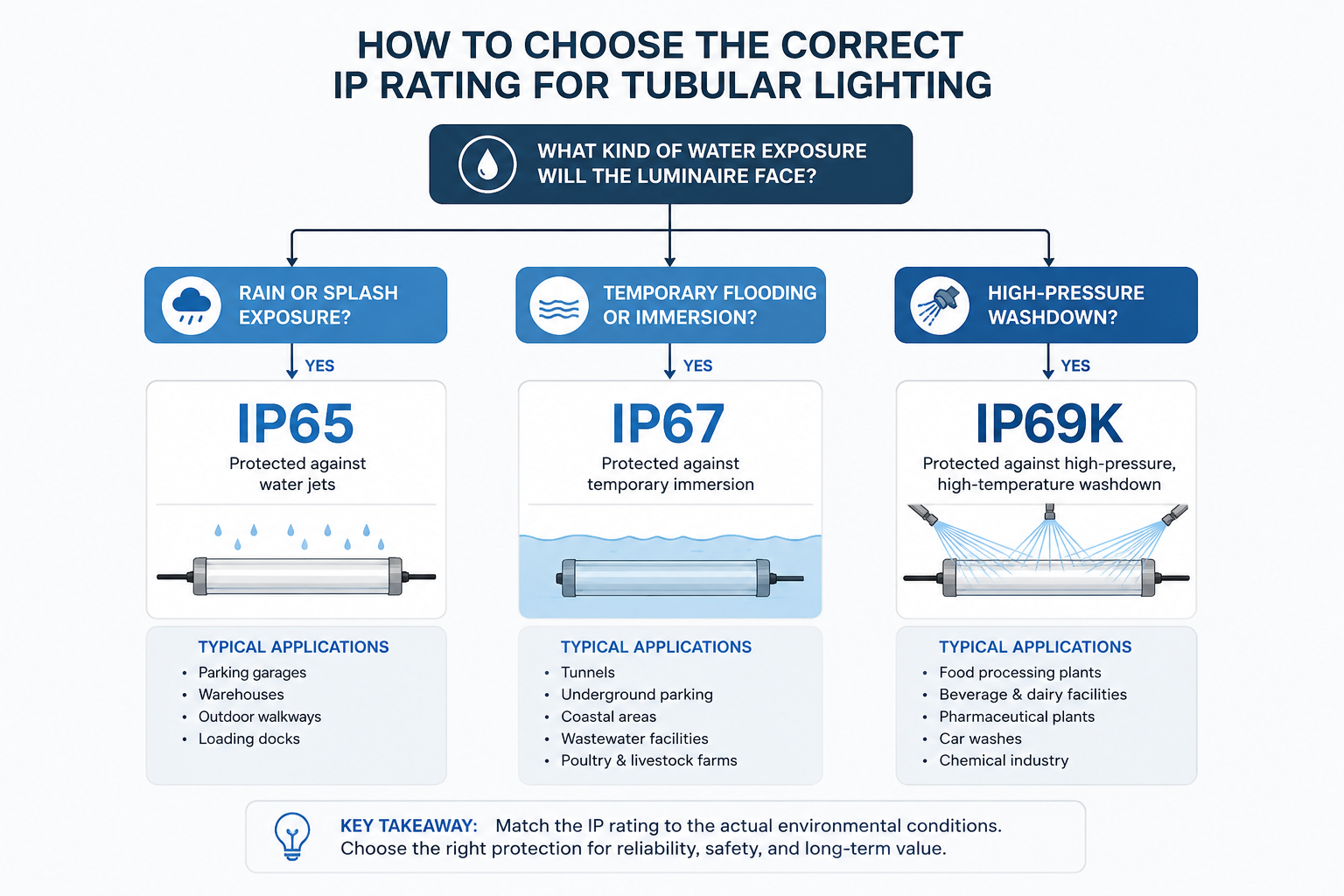
| Will the luminaire only be exposed to rain or occasional hose cleaning? | Choose IP65 |
| Could temporary flooding or standing water occur? | Choose IP67 |
| Will the fixture be cleaned using high-pressure hot water? | Choose IP69K |
| Will chemicals or sanitation procedures be used regularly? | IP69K + Corrosion-resistant materials (316L recommended) |
Common Mistakes Buyers Make When Choosing IP Ratings
Choosing the wrong protection level doesn’t always result in immediate failure.
More often, it leads to unnecessary spending, reduced service life or maintenance problems several years after installation.
Below are four mistakes lighting manufacturers frequently encounter during commercial projects.
Mistake 1: Assuming the Highest IP Rating Is Always the Best Choice
This is by far the most common misconception.
Many buyers believe IP69K is simply a premium version of IP67 and therefore suitable for every project.
In reality, that’s rarely true.
For example, an office parking garage rarely undergoes high-pressure sanitation. Installing IP69K luminaires in this environment may significantly increase project costs without delivering any measurable operational benefit.
Good engineering isn’t about choosing the highest specification.
It’s about choosing the right specification.
Mistake 2: Confusing Temporary Immersion with High-Pressure Cleaning
Another common misunderstanding is assuming IP67 fixtures can withstand pressure washing.
They cannot.
An IP67 luminaire is tested under temporary immersion conditions, while an IP69K luminaire is evaluated under high-pressure, high-temperature water jets.
These represent two completely different test methods.
A fixture that survives immersion may still fail after repeated industrial washdown if its seals and cable entries were never designed for that type of mechanical stress.
Mistake 3: Looking Only at the IP Rating
The IP rating is only one part of environmental protection.
Two luminaires may both be labeled IP67, yet their long-term reliability can differ significantly depending on their engineering quality.
Important design factors include:
- Sealing system design
- Silicone gasket quality
- End-cap machining accuracy
- UV-resistant diffuser materials
- Corrosion-resistant hardware
- Waterproof cable glands
- Manufacturing tolerances
A certification label alone cannot reveal these differences.
Mistake 4: Ignoring the Cleaning Process
Many buyers focus on water exposure but overlook how the fixture will actually be maintained.
For example:
A tunnel may experience flooding once every few years.
A food factory may wash every luminaire twice every day.
Although the tunnel encounters more water volume, the food factory places much greater stress on sealing materials over time because of repeated hot-water cleaning, detergents and temperature cycling.
Understanding the maintenance process is therefore just as important as understanding the installation environment.
Why IP Rating Alone Doesn’t Guarantee a Long-Lasting Luminaire
This is perhaps the most important concept in this guide.
An IP rating confirms that a product successfully passed a standardized laboratory test.
It does not guarantee that the luminaire will remain waterproof after five or ten years of continuous operation.
Long-term durability depends on many additional engineering decisions.
For premium tubular lighting, these often include:
- High-quality silicone gaskets that resist aging and compression set
- Precision-machined sealing surfaces that maintain uniform gasket pressure
- UV-stabilized PC or PMMA tubes that resist yellowing and cracking
- Corrosion-resistant stainless steel end caps and mounting hardware
- Pressure-balanced enclosure designs that reduce seal fatigue caused by thermal expansion
- Waterproof cable glands and connectors designed for repeated maintenance
- Robust mechanical construction capable of maintaining sealing performance after vibration and impact
In demanding industrial environments, these design details often have a greater influence on service life than the IP rating itself.
This is why professional lighting specifications typically evaluate the complete enclosure system, rather than relying solely on the protection rating shown on a datasheet.
Expert InsightFrom an engineering perspective, IP certification is the starting point—not the finish line.
When evaluating tubular lighting for long-term commercial use, consider the complete environmental protection strategy:
- Appropriate IP rating
- IK impact resistance
- Housing material
- Corrosion resistance
- UV stability
- Sealing technology
- Thermal management
- Ease of maintenance
A well-balanced design usually delivers greater reliability than simply selecting the highest available IP rating.
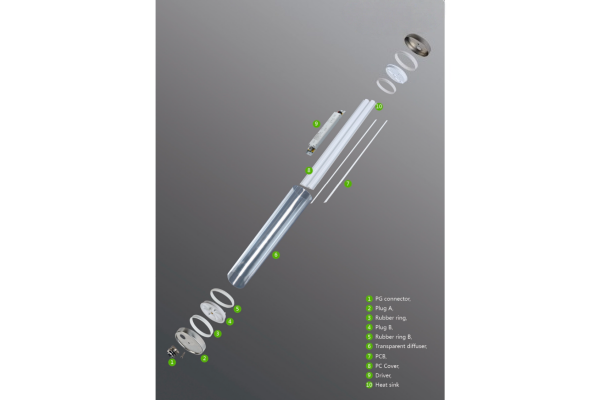
Environmental protection is only one aspect of luminaire selection. Material choice also plays a critical role in durability. In our upcoming guide comparing PC, PMMA and borosilicate glass, we’ll explain how different diffuser materials affect UV resistance, impact strength, chemical compatibility and long-term optical performance.
Recommended IP Ratings by Application
Choosing the correct IP rating becomes much easier when you start with the actual application rather than the specification sheet.
The table below summarizes the protection level typically recommended for common commercial and industrial environments.
| Application | Typical Environment | Recommended IP Rating | Reason |
|---|---|---|---|
| Office | Dry indoor environment | IP20–IP40 | Water protection generally unnecessary |
| Covered Parking Garage | Dust, humidity, rain | IP65 | Protection against dust and water jets |
| Warehouse | Dust and occasional cleaning | IP65 | Suitable for routine industrial environments |
| Outdoor Walkway | Rain and weather exposure | IP65 | Reliable outdoor weather protection |
| Metro Tunnel | Flooding, condensation | IP67 | Temporary immersion protection |
| Underground Infrastructure | Standing water | IP67 | Better protection during unexpected flooding |
| Cold Storage | Condensation, humidity | IP67 | Helps maintain enclosure integrity |
| Poultry Farm | Humidity, ammonia, regular washing | IP67 / IP69K | Depends on cleaning frequency |
| Food Processing Plant | Daily high-pressure washdown | IP69K | Designed for hygienic cleaning procedures |
| Beverage Factory | Steam and sanitation | IP69K | Frequent high-pressure cleaning |
| Pharmaceutical Plant | Strict hygiene requirements | IP69K | High-temperature washdown resistance |
| Automatic Car Wash | Continuous high-pressure water | IP69K | Maximum protection against washdown |
Conclusion
There is no universally “best” IP rating.
The right choice depends entirely on how the luminaire will interact with its environment throughout its service life.
If the fixture is exposed to rain or occasional hose cleaning, IP65 is often the most economical and practical solution.
If temporary flooding or persistent condensation is a concern, IP67 provides an additional level of protection against water ingress.
Where luminaires must withstand frequent high-pressure, high-temperature washdown—such as food processing, pharmaceutical manufacturing or commercial vehicle washing—IP69K is generally the preferred option.
However, environmental protection should never be evaluated by IP rating alone.
Long-term reliability also depends on enclosure design, sealing technology, material selection, corrosion resistance and manufacturing quality.
By matching the protection rating to the actual operating conditions—not simply selecting the highest number—you can achieve a more reliable installation, lower maintenance costs and better long-term value.
Frequently Asked Questions
Is IP69K better than IP67?
Not necessarily.
IP67 protects against temporary immersion, while IP69K protects against high-pressure, high-temperature washdown. They address different environmental challenges rather than representing different quality levels.
Is IP65 sufficient for outdoor tubular lighting?
In most commercial outdoor applications, yes.
Parking garages, building facades, covered walkways and warehouses typically require protection against rain and water jets rather than immersion or industrial washdown.
Can IP67 luminaires be pressure washed?
No.
IP67 certification does not include high-pressure washdown testing. Facilities using industrial cleaning equipment should generally specify IP69K luminaires.
Why are IP69K tubular luminaires more expensive?
Because they usually require:
- Higher-quality sealing systems
- More precise machining
- Better cable glands
- Corrosion-resistant materials
- More demanding manufacturing tolerances
The additional cost reflects engineering complexity rather than the certification itself.
Does IP69K mean the luminaire can be permanently submerged?
No.
IP69K evaluates resistance to high-pressure, high-temperature water jets.
Continuous immersion falls under IP68 testing, which follows different procedures.
Besides IP rating, what other specifications should I consider?
Important specifications include:
- IK impact resistance
- Housing material
- UV resistance
- Corrosion resistance
- Operating temperature
- Driver reliability
- Dimming compatibility
- Warranty
Considering these factors together provides a much better indication of long-term durability.
Which IP rating is recommended for food processing plants?
Most food and beverage facilities require IP69K because luminaires are routinely cleaned using high-pressure hot water and sanitation chemicals.