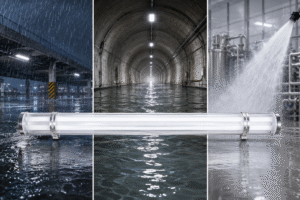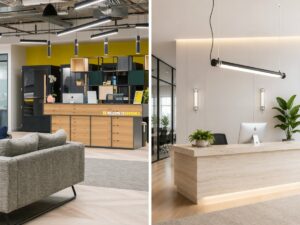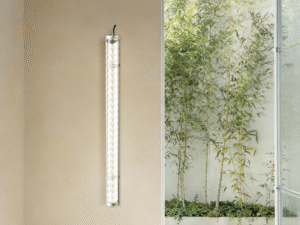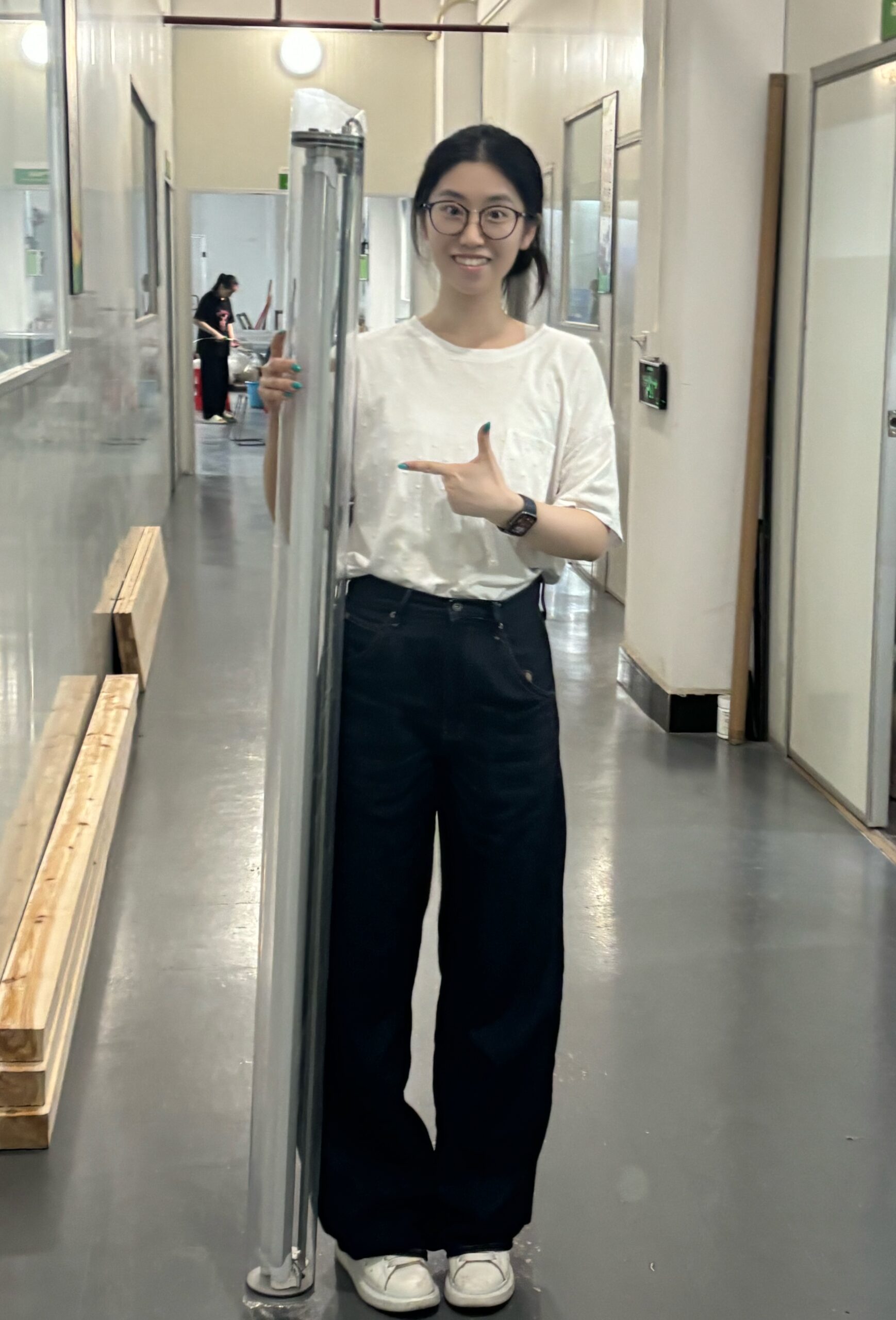
The tubular housing is one of the most visible parts of a tubular luminaire, but its role goes far beyond appearance.
It influences the luminaire’s impact resistance, optical efficiency, light uniformity, UV stability, chemical compatibility, cleaning resistance and long-term reliability.
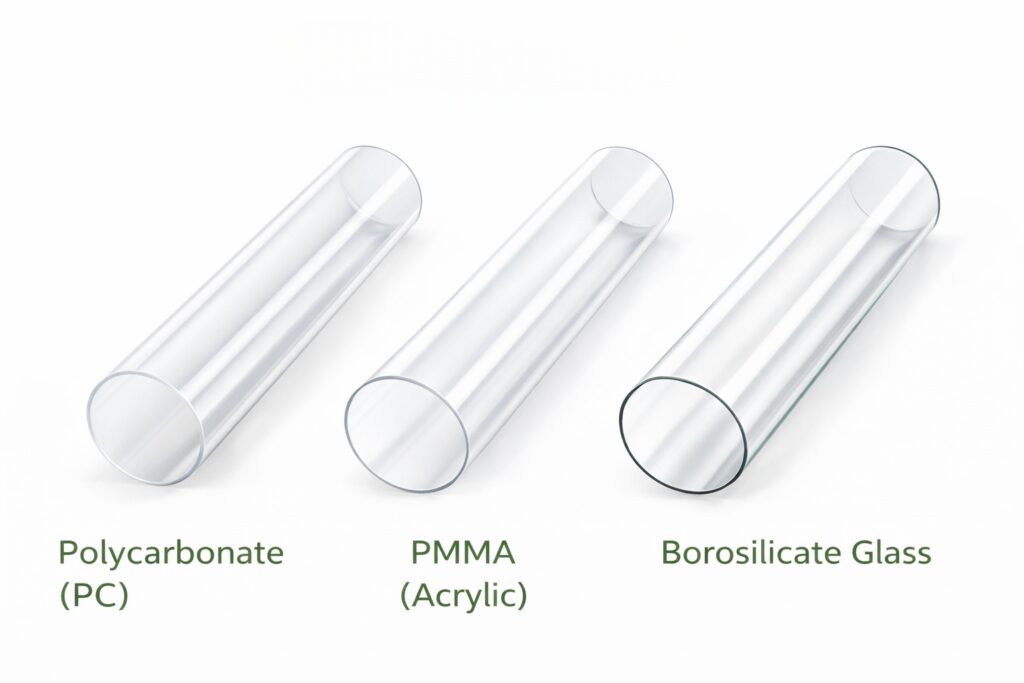
The three materials most commonly considered for professional tubular lighting are:
- Polycarbonate (PC)
- Polymethyl methacrylate (PMMA or acrylic)
- Borosilicate glass
There is no universally “best” material. A polycarbonate housing may be ideal for a car park exposed to accidental impact, while PMMA may be more suitable for a decorative suspended luminaire. In food-processing, chemical or high-pressure washdown environments, borosilicate glass may provide advantages that plastics cannot offer.
The correct choice therefore depends on the application environment, optical objective, mechanical risk, maintenance method and required certification, rather than material price alone.
This guide compares PC, PMMA and borosilicate glass from a practical luminaire-engineering perspective and explains what lighting designers, contractors and procurement teams should verify before approving a specification.
Why Housing Material Matters in Tubular Lighting
In a conventional rectangular luminaire, the diffuser is normally supported by a separate metal or plastic body.
In many tubular luminaires, however, the tube itself may perform several functions simultaneously:
- Protect the LED module and driver
- Form the main optical surface
- Support the end-cap sealing system
- Resist external impact
- Maintain the luminaire’s cylindrical appearance
- Protect internal components from dust, moisture and cleaning processes
This means material selection affects not only the visual appearance of the luminaire but also its mechanical construction and environmental protection.
A material that performs well optically may not tolerate mechanical impact. A highly impact-resistant polymer may require UV stabilization or careful chemical compatibility checks. A glass tube may resist aggressive detergents but require stronger packaging, more precise mounting and more careful on-site handling.
Do not select a tubular housing material from a material datasheet alone.
The final performance depends on the complete luminaire construction, including:
- Tube diameter
- Wall thickness
- Extrusion or forming quality
- End-cap design
- Gasket material
- Cable gland
- Internal support structure
- Mounting distance
- Thermal management
- Assembly tolerances
For example, polycarbonate is an impact-resistant material, but this does not automatically mean that every PC tubular luminaire is IK10. Likewise, using borosilicate glass does not automatically make a product IP69K.
IP ratings apply to the protection delivered by the complete enclosure, while IK ratings classify the resistance of the complete enclosure to external mechanical impact.
Quick Comparison: PC vs PMMA vs Borosilicate Glass
| Selection Factor | Polycarbonate (PC) | PMMA (Acrylic) | Borosilicate Glass |
|---|---|---|---|
| Impact Resistance | ★★★★★ Highest impact resistance among the three materials. Commonly selected for areas exposed to vibration, accidental impact or public access. | ★★★☆☆ Good rigidity and excellent optical appearance, but lower impact resistance compared with PC. | ★★★☆☆ High hardness and mechanical strength, but brittle failure must be considered during design and installation. |
| Typical IK Rating of Complete Luminaire | Typically IK10 achievable depending on tube thickness, material grade, mechanical structure and complete luminaire testing. | Typically IK06–IK08 achievable depending on wall thickness, support structure and impact protection design. | Typically IK06–IK08 achievable depending on glass thickness, mounting design and protective structure. |
| Optical Transmission | Approx. 85–90% depending on grade and diffusion level. Available in clear, opal and diffused versions. | Approx. 90–92% for clear grades. Excellent transparency and premium visual appearance. | Excellent transparency with stable optical performance over long service periods. |
| Light Diffusion & Glare Control | Excellent flexibility. Opal and diffused versions provide good LED concealment and improved visual comfort. | Excellent clarity, but additional diffuser solutions may be required for glare control. | Usually requires diffuser films, coatings or internal optical structures for glare control. |
| UV Resistance | Requires UV-stabilised grades or protective treatment for long-term outdoor exposure. | Excellent weather resistance with low yellowing tendency. | Excellent UV stability with no polymer ageing mechanism. |
| Chemical Resistance | Good general resistance, but some solvents and cleaners may cause stress cracking under certain conditions. | Good resistance to many chemicals, but solvent and alcohol compatibility should be verified. | Excellent resistance to many chemicals and repeated cleaning processes. |
| Thermal Performance | Good thermal performance for LED applications. Actual performance depends on material grade and thermal design. | Suitable for normal LED applications, but generally lower temperature capability than PC and glass. | Excellent thermal shock resistance and suitable for demanding temperature cycles. |
| Scratch Resistance | Lower surface hardness. Anti-scratch coating or careful cleaning procedures may be required. | Higher surface hardness than PC and better appearance retention. | Excellent scratch resistance due to its hard glass surface. |
| Typical IP Rating Applications | IP65 / IP67 / IP68 / IP69K achievable depending on sealing system and complete luminaire design. | IP65 / IP67 commonly used. Higher ratings depend on complete fixture construction. | IP67 / IP68 / IP69K commonly selected for washdown and demanding industrial environments. |
| Weight & Installation | Lightweight and easy to install, especially for long tubular fixtures. | Lightweight and easy to process. | Heavier and requires more careful transportation and installation. |
| Typical Applications | Parking garages, metro stations, warehouses, tunnels, workshops and public areas. | Architectural lighting, hospitality projects, decorative applications and premium interior spaces. | Food processing, cold storage, washdown areas and chemical environments. |
| Main Limitation | Chemical compatibility and UV performance must be confirmed for the actual application environment. | Lower impact resistance compared with PC and higher sensitivity to mechanical stress. | Higher weight, handling requirements and breakage management considerations. |
The descriptions above are selection tendencies rather than guaranteed product ratings. The exact result depends on the resin or glass grade, tube dimensions and complete luminaire construction. Covestro describes optical-grade polycarbonate as transparent, tough and impact-resistant, while Röhm reports light transmission of up to 92% for clear PLEXIGLAS® grades and emphasizes their UV stability. SCHOTT’s borosilicate data highlights low thermal expansion, thermal-shock resistance and high chemical durability.
Polycarbonate Tubular Lighting
Polycarbonate is generally the first material considered when a tubular luminaire must resist accidental impact, vibration or public access.
Its combination of toughness, low weight and manufacturing flexibility makes it suitable for industrial and infrastructure lighting.
Typical applications include:
- Car parks
- Warehouses
- Workshops
- Railway and metro stations
- Public circulation areas
- Sports facilities
- Livestock and agricultural buildings
- Outdoor covered areas
PC tubes can be produced in clear, frosted or opal versions. They can also accommodate different internal optical systems, including linear diffusers, reflectors, louvers, decorative meshes and lens modules.
Main Advantages of PC
High impact resistance
PC is usually the preferred option where the luminaire may be struck by tools, luggage, balls, maintenance equipment or other moving objects.
Low weight
Its lower weight can simplify suspension, wall mounting, handling and transport, particularly for long tubular luminaires.
Manufacturing flexibility
Polycarbonate can be extruded into different diameters, wall thicknesses, surface finishes and diffusion levels.
Suitable for long tubular constructions
The material’s toughness makes it useful for long luminaires where transportation and installation stresses may be significant.
Limitations of PC
Polycarbonate is not automatically suitable for every industrial environment.
Potential limitations include:
- Scratching during cleaning
- Yellowing when a non-UV-stabilized grade is used outdoors
- Stress cracking after contact with incompatible chemicals
- Dimensional movement under temperature changes
- Reduced optical efficiency when a highly diffused compound is used
UV-stabilized grades should therefore be specified for luminaires exposed to sunlight or significant UV radiation. Polymeric outdoor enclosures may also require evaluation after UV and low-temperature exposure under applicable certification programs.
Practical Insight: Check Cleaning-Chemical Compatibility
A common procurement mistake is to approve a PC luminaire based only on its IP rating.
An IP69 or IP69K test evaluates resistance to a specified water test. It does not automatically confirm resistance to every detergent, disinfectant, oil, solvent or degreasing agent used at the project site.
Before using PC in a food plant, car wash or industrial cleaning area, request:
- The cleaning-agent name
- Concentration
- Water temperature
- Cleaning frequency
- Contact time
- Rinsing procedure
The housing, seals, cable glands and end caps should then be checked for chemical compatibility.
PMMA Tubular Lighting
PMMA, commonly called acrylic, is often selected for architectural tubular lighting because of its high optical clarity, excellent weathering resistance and premium visual appearance.
Clear PLEXIGLAS® material can provide light transmission of up to 92%, although the actual transmission of an opal lighting tube will be lower because diffusion additives intentionally scatter and absorb part of the light.
Typical PMMA applications include:
- Offices
- Hotels
- Restaurants
- Retail stores
- Reception areas
- Residential developments
- Decorative suspended lighting
- Architectural feature lighting
Main Advantages of PMMA
High optical quality
PMMA is well suited to products where visual clarity, surface brilliance and premium appearance are important.
Excellent UV stability
Suitable PMMA grades offer strong resistance to UV exposure and outdoor weathering, helping maintain appearance and light transmission over time. Plexiglas
Good light-diffusion options
Lighting-grade PMMA can combine efficient transmission with controlled diffusion, reducing visible LED points while maintaining a clean illuminated surface.
Good surface appearance
Compared with uncoated PC, PMMA generally offers a harder, more visually stable surface that is less prone to fine cleaning scratches.
Limitations of PMMA
PMMA is more brittle than polycarbonate and can be more sensitive to:
- Transportation impact
- Over-tightened screws or end caps
- Concentrated mounting pressure
- Sharp internal features
- Machining notches
- Dropping during installation
- Thermal stress around rigid joints
For long tubular luminaires, packaging and internal support are especially important.
Practical Insight: Avoid Concentrated Stress
Cracks do not always appear immediately after assembly.
A PMMA tube may pass initial inspection but later develop cracking around:
- Screw holes
- Machined slots
- Cable exits
- Mounting clips
- End-cap interfaces
This can occur when residual machining stress combines with installation pressure, temperature cycling or chemical exposure.
A reliable PMMA design should avoid sharp corners, excessive interference fits and uncontrolled clamping force.
Borosilicate Glass Tubular Lighting
Borosilicate glass is normally selected when the application requires stronger resistance to temperature changes, aggressive cleaning, chemical exposure, abrasion or high-pressure washdown.
Its low thermal expansion helps it tolerate temperature gradients better than conventional soda-lime glass. SCHOTT lists a coefficient of linear thermal expansion of approximately 3.25 × 10⁻⁶ K⁻¹ for BOROFLOAT® 33 and highlights its resistance to thermal shock and chemical attack. SCHOTT
Typical applications include:
- Food and beverage production
- Commercial kitchens
- Car washes
- Cold-storage facilities
- Pharmaceutical production
- Chemical-processing areas
- High-humidity facilities
- Poultry and livestock buildings
- Industrial washdown zones
Main Advantages of Borosilicate Glass
High chemical durability
Borosilicate glass offers strong resistance to many acids, alkalis, cleaning agents and industrial contaminants.
Thermal stability
Its low thermal expansion makes it suitable for environments involving temperature changes or hot-water cleaning.
Scratch and abrasion resistance
Glass is less likely than an uncoated plastic tube to develop visible cleaning scratches during repeated maintenance.
Long-term optical stability
Glass does not suffer from polymer yellowing and generally maintains its surface appearance in demanding environments.
Limitations of Borosilicate Glass
Despite its strong chemical and thermal performance, borosilicate glass remains a brittle material.
Its performance can be influenced by:
- Wall thickness
- Tube diameter
- Surface damage
- Edge finishing
- Mounting distance
- Gasket compression
- End-cap alignment
- Transport shock
- Installation handling
A small scratch or damaged edge can reduce the practical strength of a glass component.
Practical Insight: Glass Requires a Different Mechanical Design
A glass tubular luminaire should not simply use the same construction as a PC luminaire with the tube material replaced.
The design should consider:
- Flexible gasket interfaces
- Controlled axial compression
- Protection against metal-to-glass contact
- Suitable bracket spacing
- Prevention of torsional loading
- Packaging that limits point impact
- Clear installation instructions
The mechanical properties of finished glass components can be significantly affected by secondary processing, edge quality, strengthening treatment and mounting conditions
Is PC Always IK10 and Glass Always IK08?
No.
This is one of the most important points when comparing tubular-lighting materials.
IK is an enclosure rating, not a raw-material rating.
IEC 62262 classifies the protection provided by electrical enclosures against external mechanical impacts. The final result must therefore be verified on the complete luminaire configuration. IEC Webstore
A tubular luminaire’s IK performance can be affected by:
- Tube wall thickness
- Diameter
- Length
- Impact location
- Internal support
- Mounting distance
- End-cap construction
- Bracket rigidity
- Material grade
- Test temperature
For example, a short, thick-wall PC tube may behave very differently from a long, thin-wall tube made from another PC grade.
Similarly, two glass luminaires using the same nominal glass composition may achieve different impact results because of differences in wall thickness, processing and support structure.
Recommended Specification Language
Avoid writing: PC material, therefore IK10.
A more professional specification is: Complete luminaire tested to IK10 in accordance with the applicable impact test standard.
This requires the supplier to provide a result for the assembled product rather than relying only on the material name.
Does the Tube Material Determine the IP Rating?
Not by itself.
IEC 60529 classifies enclosure protection against access, dust and water ingress. The rating applies to the complete enclosure rather than only the tube. IEC Webstore
For a tubular luminaire, IP performance depends on the combined performance of:
- Tube
- End caps
- Sealing gaskets
- Cable glands
- Connecting cables
- Breathing devices, when used
- Assembly process
- Screw torque
- Adhesive or potting system
- Thermal expansion of different materials
A high-quality tube cannot compensate for a poorly compressed gasket or incorrectly sized cable gland.
Practical Insight: IP Tests Do Not Cover Every Real-World Failure Mode
A luminaire may pass an initial ingress test but still develop field problems if:
- The gasket takes a permanent compression set
- Thermal cycling changes the sealing pressure
- The cable is pulled during installation
- Cleaning chemicals damage the seal
- The installer opens and incorrectly reassembles the end cap
- Condensation forms because moist air was trapped during assembly
For demanding projects, consider supplementing the standard IP test with:
- Thermal cycling
- Ageing tests
- Repeated washdown
- Cable-pull testing
- Chemical exposure
- Post-ageing IP verification
For further guidance, read IP65 vs IP67 vs IP69K Tubular Lighting.
Clear Transmission Is Not the Same as Luminaire Efficiency
Material transmission figures are frequently misused during product comparison.
A supplier may state:
- Clear PMMA: approximately 92% transmission
- Clear PC: a lower or similar grade-specific value
- Clear glass: high transmission
However, these figures do not directly predict the finished luminaire’s efficacy.
A tubular luminaire’s delivered lumens are also affected by:
- Opal or frosted pigmentation
- Tube wall thickness
- Surface texture
- LED position
- Internal reflector
- PCB width
- Optical distance
- Multiple internal reflections
- End-cap shadow
- Driver efficiency
- LED operating temperature
Practical Example
A clear PMMA tube may have high material transmission but expose visible LED points.
An opal PC tube may have lower transmission but create a more uniform luminous surface.
The correct choice depends on whether the project prioritizes:
- Maximum luminous efficacy
- Visual comfort
- Low LED visibility
- Decorative appearance
- 180° or 360° light distribution
- UGR control
Therefore, suppliers should provide complete luminaire photometric data, not only raw-material transmission values.
Which Material Should You Choose?
| Project Requirement | Recommended Starting Point | Reason | Important Verification |
|---|---|---|---|
| High accidental-impact risk | Polycarbonate (PC) | High toughness and low breakage risk, making it suitable for industrial facilities, public areas and locations exposed to vibration or accidental impact. | Complete luminaire IK test, tube thickness, material grade and mounting structure. |
| Premium architectural appearance | PMMA (Acrylic) | Excellent optical clarity, premium surface appearance and strong UV stability for architectural and decorative lighting applications. | Impact risk, installation stress, optical uniformity and long-term appearance. |
| Outdoor public installation | UV-stabilized Polycarbonate (PC) | Provides a balanced solution between impact resistance, lightweight construction and outdoor weather performance. | UV grade, IK rating, IP rating and operating temperature range. |
| High-pressure washdown | Borosilicate Glass or Chemically Compatible PC | The material must withstand water pressure, temperature changes and repeated exposure to cleaning chemicals. | Complete IP test, chemical compatibility, gasket durability and sealing design. |
| Food-processing environment | Borosilicate Glass | Excellent chemical resistance, abrasion resistance and thermal stability for demanding hygiene environments. | Breakage management, mounting protection, hygiene requirements and relevant certifications. |
| Long suspended decorative luminaire | PMMA or PC | Lower weight and easier handling compared with glass, making it suitable for long suspended tubular designs. | Deflection, suspension spacing, optical uniformity and transport packaging. |
| Aggressive chemical environment | Borosilicate Glass | Provides higher resistance to many aggressive chemicals and industrial contaminants. | Chemical type, concentration, exposure duration and seal compatibility. |
Application-Based Recommendations
Car Parks and Public Areas
Recommended starting point: UV-stabilized PC
Car parks and public areas frequently involve accidental impact, vibration, dust, moisture and possible vandalism. A tested PC luminaire with an appropriate IK and IP rating is usually the most practical option.
Offices, Hotels and Retail Spaces
Recommended starting point: PMMA or architectural-grade PC
PMMA is suitable where optical quality and visual appearance are the priority. PC may be preferred when the installation is accessible to the public or exposed to a greater impact risk.
To understand how tubular products differ from conventional rectangular fixtures, read Tubular Lighting vs Linear Lighting.
Food and Beverage Facilities
Recommended starting point: Borosilicate glass
Glass may be preferred where the luminaire will be repeatedly exposed to hot water, detergents, grease, steam or aggressive cleaning.
However, the project should also evaluate breakage risk and determine whether the luminaire requires protective mounting or a documented glass-management procedure.
Cold Storage
Recommended starting point: PC or borosilicate glass
The decision depends on whether impact resistance or chemical and thermal stability is more important.
The supplier should verify:
- Minimum ambient temperature
- Start-up performance
- Gasket flexibility
- Driver operating range
- Condensation behaviour
- Thermal shock during washdown
Car Washes
Recommended starting point: Borosilicate glass or validated chemical-resistant PC
High-pressure water is only one part of the operating environment. Car-wash detergents, waxes, alkaline cleaners and temperature changes may be equally important.
Poultry and Livestock Buildings
Recommended starting point: PC or borosilicate glass
PC offers impact resistance and lower weight. Glass may offer better resistance to ammonia, aggressive cleaning and repeated washdown, depending on the exact environment.
A chemical-compatibility assessment should be completed before final material approval.
Common Material-Selection Mistakes
Mistake 1: Selecting Only by Light Transmission
The material with the highest clear transmission is not always the best lighting solution. Uniformity, glare, LED visibility and distribution must also be considered.
Mistake 2: Assuming All PC Is the Same
Different PC grades may have different UV, optical, flame-retardant, impact and processing characteristics.
Mistake 3: Treating IP69K as Chemical Resistance
High-pressure water protection does not automatically demonstrate resistance to cleaning chemicals.
Mistake 4: Using Raw-Material Temperature Limits as Luminaire Ratings
The complete luminaire operating temperature is normally limited by the most temperature-sensitive component, which may be the LED driver, LED module, cable, connector, gasket or battery rather than the tube.
IEC 60598-1 establishes general safety requirements and tests for luminaires, including mechanical and electrical construction. Complete-product compliance should therefore take priority over isolated raw-material values.
Mistake 5: Changing Materials After Certification
Replacing PC with PMMA or changing tube wall thickness may affect:
- Impact performance
- Thermal behaviour
- Flammability
- Sealing compression
- Creepage and clearance
- Optical output
- Certification validity
Any material change should be reviewed through the product’s technical change-control process.
PC vs PMMA vs Borosilicate Glass: Final Recommendation
Choose polycarbonate when the project prioritizes:
- Impact resistance
- Low weight
- Long tubular construction
- Public-area safety
- Industrial durability
Choose PMMA when the project prioritizes:
- Premium appearance
- High optical clarity
- UV stability
- Architectural integration
- Decorative light quality
Choose borosilicate glass when the project prioritizes:
- Chemical durability
- Thermal stability
- Scratch resistance
- Repeated washdown
- Harsh industrial or hygienic environments
The final selection should always be based on the complete application and complete luminaire, not on one isolated material property.
For an overview of tubular luminaire construction, optical options and applications, read The Ultimate Guide to Tubular Lighting.
New to this luminaire category? Start with What Is Tubular Lighting?.
Frequently Asked Questions
Is PC better than PMMA for tubular lighting?
PC is normally better for applications with a high risk of impact, vibration or rough handling. PMMA is often better when optical clarity, UV stability and premium appearance are the main priorities.
The correct choice depends on the application rather than one material being universally better.
Does PMMA turn yellow outdoors?
High-quality, UV-stable PMMA is known for excellent long-term weathering performance. However, the actual result depends on the material grade, pigmentation, processing and operating environment.
Is borosilicate glass stronger than polycarbonate?
Borosilicate glass provides excellent chemical, thermal and surface performance, but it is more brittle than polycarbonate.
Polycarbonate normally provides better resistance to sudden mechanical impact, while borosilicate glass may perform better under chemical exposure, abrasion and temperature changes.
Which material is best for IP69K tubular lighting?
There is no single answer.
Borosilicate glass is often selected for high-pressure washdown and chemically demanding areas, while validated PC constructions may also be suitable for certain washdown applications.
The claimed IP rating must be tested on the complete luminaire.
Is glass always better for food-processing lighting?
Not always.
Glass offers strong chemical, thermal and abrasion resistance, but the project must also consider impact risk, breakage management, weight, mounting and maintenance requirements.
In some facilities, a tested impact-resistant polymer construction may be preferred.
Conclusion
PC, PMMA and borosilicate glass each solve a different lighting-engineering problem.
PC provides toughness and flexibility. PMMA provides optical quality and architectural appearance. Borosilicate glass provides chemical and thermal durability.
However, the material name alone cannot guarantee the performance of a tubular luminaire.
A professional specification should evaluate:
- Exact material grade
- Wall thickness
- Optical configuration
- Complete IK rating
- Complete IP rating
- Chemical compatibility
- Operating temperature
- Sealing design
- Photometric performance
- Production consistency
By evaluating these factors together, lighting designers and procurement teams can choose a tubular luminaire that not only performs well during initial testing but also remains reliable throughout the life of the project.
Need Help Selecting a Tubular Lighting Material?
MANI Lighting develops customizable tubular luminaires for architectural, commercial and industrial projects.
Depending on the application, our tubular lighting solutions can be configured with:
- Polycarbonate, PMMA or borosilicate glass housings
- Clear, frosted or opal finishes
- Different diameters and lengths
- IP65, IP67, IP68 or high-pressure washdown configurations
- Multiple impact-resistance options
- 180° or 360° light distribution
- ON/OFF, TRIAC, 0–10V and DALI control
- Stainless-steel or aluminium end caps
- Custom mounting and connection systems
Contact MANI Lighting to discuss your project environment, optical requirements and target certification.
References
- International Electrotechnical Commission. Ingress Protection Ratings and IEC 60529 .
- International Electrotechnical Commission. IEC 62262: Degrees of Protection Against External Mechanical Impacts .
- Covestro. Makrolon Polycarbonate Material Properties .
- Röhm GmbH. PLEXIGLAS Optical and Material Properties ; PLEXIGLAS UV Resistance .
- SCHOTT. BOROFLOAT 33 Thermal Properties .
- International Electrotechnical Commission. IEC 60598-1:2024 — Luminaires, General Requirements and Tests .