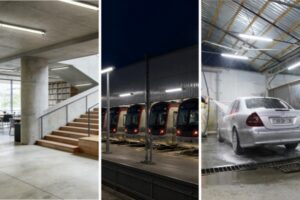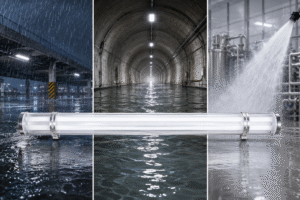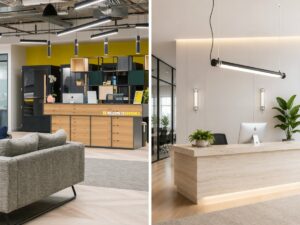
Architectural LED wall lights for commercial use are not selected only for brightness. In real projects, the fixture must match the building environment, installation method, protection level, lighting effect, control system, and long-term maintenance requirements.
For hotels, parking structures, public corridors, retail façades, outdoor walkways, and commercial entrances, the wrong wall light can create several problems: uneven lighting, glare, water ingress, loose mounting, control incompatibility, or early failure. That is why commercial architectural lighting needs to be specified differently from ordinary decorative wall lights.
At MANI Lighting, we often receive project requests where the client already has a design concept, but the technical requirements are not fully defined. In most cases, the best solution is not simply “the most powerful fixture.” It is the fixture that fits the site conditions.
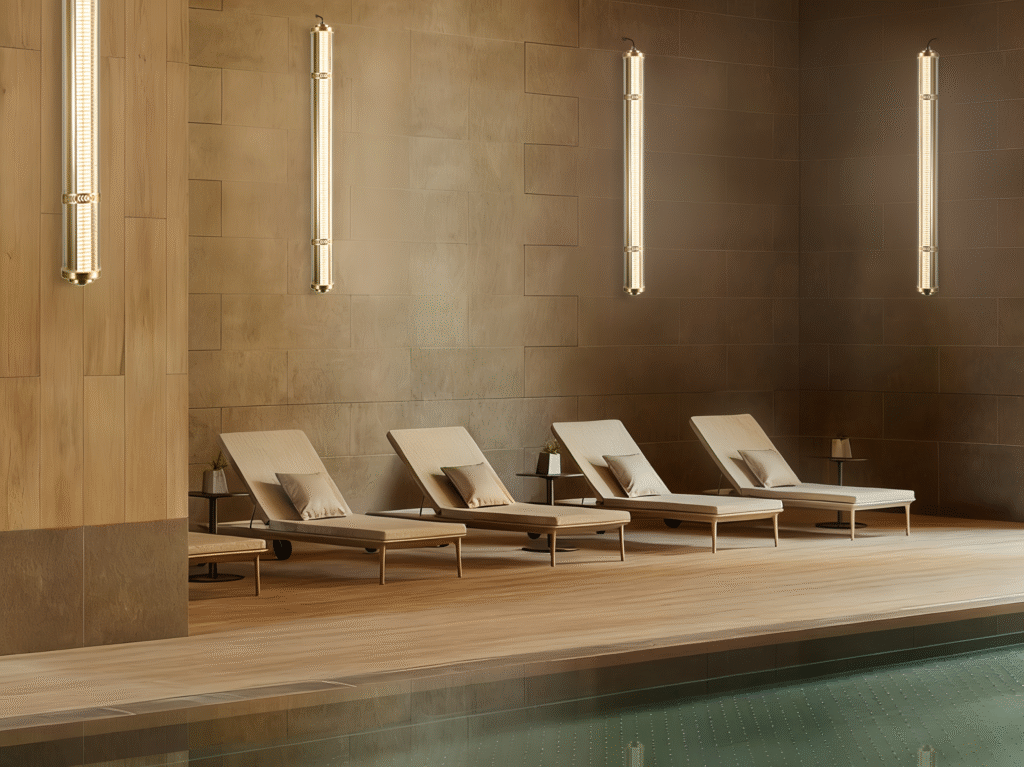
What Are Architectural LED Wall Lights?
Architectural LED wall lights are wall-mounted luminaires designed to become part of the building’s visual language while also delivering functional illumination. Unlike basic wall lamps, commercial architectural wall lights usually need to meet project-level requirements such as:
- Customized length, diameter, color temperature, and finish
- Indoor, semi-outdoor, or outdoor protection
- Single-side, double-side, or 360° light distribution
- Anti-glare design for corridors and public areas
- DALI, 0-10V, TRIAC, sensor, or on/off control
- Consistent light color for multi-zone installation
- Durable materials for long-term commercial operation
Flexible mounting options for real project conditions
For tubular architectural wall lights, the fixture shape itself becomes part of the design. A linear tubular form can create a clean, modern visual line on walls, columns, entrances, and façades.
Lighting Performance Is More Than Brightness
In commercial lighting projects, brightness alone does not define a good wall light. A fixture with high lumen output may still create poor visual comfort if the light distribution is uncontrolled, the diffuser is too bright, or the luminaire is installed directly in the user’s field of view.
For architectural LED wall lights, the following lighting parameters should be reviewed together:
Luminous flux shows the total light output of the fixture, but it does not explain where the light goes.
Light distribution determines whether the fixture produces a narrow wall-washing effect, a wide ambient glow, an up-and-down beam, or a 360° decorative luminous surface.
Glare control is critical in corridors, parking structures, stairways, and public areas where people may see the fixture directly.
Vertical illuminance affects how bright walls, faces, signage, and architectural surfaces appear.
Color consistency is important when multiple wall lights are installed along the same corridor, façade, or commercial interior.
CRI and CCT affect how materials, finishes, merchandise, and architectural textures are perceived.
This is why commercial wall lighting should be evaluated as a complete optical system, not only as a decorative product.
| Lighting Parameter | Why It Matters | What to Check in Commercial Projects |
|---|---|---|
| Luminous flux | Indicates total light output | Check the actual delivered lumen output, not only LED chip lumen data |
| Light distribution | Defines how the light reaches walls, floors, ceilings, or users | Confirm single-side, double-side, 360°, louver, lens, or diffuser design |
| Glare control | Affects visual comfort and safety | Use opal diffusers, louvers, shielding, or indirect lighting where needed |
| Vertical illuminance | Improves spatial brightness, facial recognition, and wall visibility | Important for corridors, entrances, hospitality areas, and public spaces |
| CRI | Affects color rendering of materials, finishes, and people | CRI ≥80 for general use; CRI ≥90 for hospitality, retail, or high-end interiors |
| SDCM | Controls visible color difference between fixtures | SDCM ≤3 is recommended for continuous architectural installations |
Why Commercial Wall Lights Need Different Selection Criteria
A decorative wall light used in a residential interior may only need to look good and provide comfortable light. A commercial LED wall light must do more.
In commercial projects, the luminaire is exposed to more complex conditions: higher daily operating hours, more users, stricter safety expectations, possible impact risk, cleaning pressure, outdoor humidity, and integration with building control systems.
The selection should begin with several practical specification points:
| Selection Point | Why It Matters | Typical Commercial Requirement |
|---|---|---|
| Mounting condition | Prevents installation mismatch and future loosening | Wall bracket, surface mounting, vertical mounting, customized bracket |
| Environmental protection | Reduces water, dust, and corrosion failure risk | IP65, IP67, IP68, or IP69K depending on site |
| Control compatibility | Prevents dimming failure or rewiring cost | On/off, 0-10V, DALI, TRIAC, microwave sensor, PIR sensor |
| Impact resistance | Important for public areas and parking structures | IK08 or IK10 for PC tube designs |
| Optical design | Controls glare and visual comfort | Opal diffuser, louver, mesh, perforated design, lens |
| Maintenance access | Reduces service cost after installation | Linkable version, quick connector, replaceable driver design |
IP ratings classify the protection of enclosures against dust and liquids, according to the IEC ingress protection rating system. [1] Impact protection is classified by the IK code under IEC 62262, which defines protection against external mechanical impacts. [2]
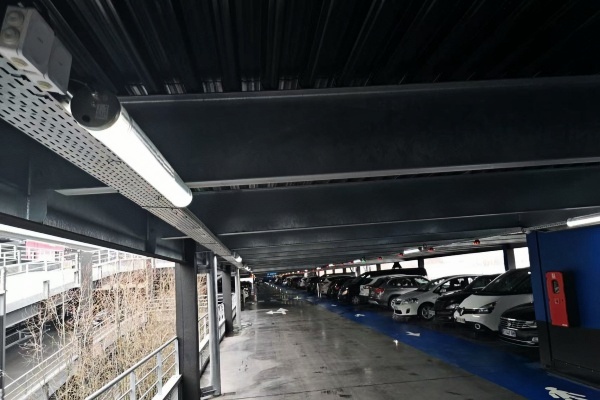
Real Project Case Study: Covered Parking Structure Wall Lighting
Project type: Covered commercial parking structure
Application area: Wall-mounted linear lighting near vehicle circulation and pedestrian zones
Main concern: Durable architectural lighting with reliable protection and clean visual appearance
Solution direction: IP67 IK10 tubular LED wall lights with controlled light distribution
Project Background
A commercial contractor approached MANI Lighting for a covered parking structure where the client wanted a clean linear wall-mounted lighting effect. At the beginning, the request was mainly aesthetic: the fixture needed to look simple, modern, and suitable for long linear installation.
After reviewing the application, we found that the product could not be treated as a normal wall light. The installation area was semi-outdoor, exposed to dust, humidity, possible cleaning water, and occasional impact risk. The fixture also needed to be installed along vehicle circulation areas, which meant glare control and mounting stability were both important.
The project evaluation focused on four technical questions:
- Would the fixture be exposed to humidity, wind-driven rain, or cleaning water?
- Would the wall-mounted position place the luminous surface within the driver’s or pedestrian’s field of view?
- Would the installation require linkable wiring to reduce on-site labor?
- Would the lighting system need simple on/off control, motion sensor control, 0-10V dimming, or DALI control?
Based on these conditions, MANI Lighting recommended an IP67 IK10 PC tubular wall light with an opal diffuser or louver option. The PC tube improved impact resistance compared with glass, while the IP67 design helped protect the internal LED module and driver connection from dust and moisture. For installation, a customized wall bracket and quick connector system were considered to improve alignment and reduce maintenance difficulty.
The final specification direction was not decided by one parameter. It was the result of balancing protection, optical comfort, installation method, control compatibility, and long-term serviceability.
Key Specification Decision
| Requirement | Project Risk | Recommended Direction |
|---|---|---|
| Covered parking structure | Dust, humidity, semi-outdoor air movement | IP67 tubular fixture |
| Public commercial use | Possible impact from users, equipment, or vehicles | IK10 PC tube |
| Wall-mounted installation | Bracket strength and alignment are critical | Customized wall mounting bracket |
| Long operating hours | Driver quality and heat management matter | Branded LED driver with stable thermal design |
| Visual comfort | Glare can affect pedestrians and drivers | Opal tube or louver design |
| Future maintenance | Difficult access after installation | Quick connector or linkable wiring option |
Final Recommendation
For this type of project, MANI Lighting would normally recommend a PC tubular architectural LED wall light with:
- IP67 protection
- IK10 impact resistance
- Opal PC cover or anti-glare louver option
- 5000K or 6000K color temperature
- CRI ≥80 or CRI ≥90 depending on project requirement
- On/off, 0-10V, or DALI dimming
- Customized wall bracket
- Optional linkable connector for easier installation
This case shows why “professional-grade wall light” is not enough as a specification. The real decision comes from matching the luminaire to the site.
Material Selection: PC, PMMA, Glass, or Metal?
The material of an architectural LED wall light strongly affects its performance, appearance, and installation environment.
| Material | Advantage | Limitation | Best Application |
|---|---|---|---|
| PC tube | High impact resistance, suitable for IK10 design | Slightly softer appearance than glass | Parking areas, corridors, public walls, outdoor projects |
| PMMA tube | Good optical clarity and attractive appearance | Lower impact resistance than PC | Commercial interiors, decorative architectural walls |
| Borosilicate glass tube | Excellent chemical resistance and premium transparency | Lower impact resistance than PC | Food processing, chemical areas, high-cleaning environments |
| Aluminum housing | Good heat dissipation and finish options | Requires proper surface treatment outdoors | Hotels, façades, shops, commercial interiors |
| Stainless steel parts | Better corrosion resistance | Higher cost | Coastal, industrial, or humid environments |
For commercial architectural wall lights, PC is often the most practical material when impact resistance is important. For premium indoor decorative projects, PMMA or glass may be preferred because of the visual finish. For demanding environments, stainless steel accessories or customized metal finishes may be required.
Light Distribution: Single-Side, Double-Side, or 360°?
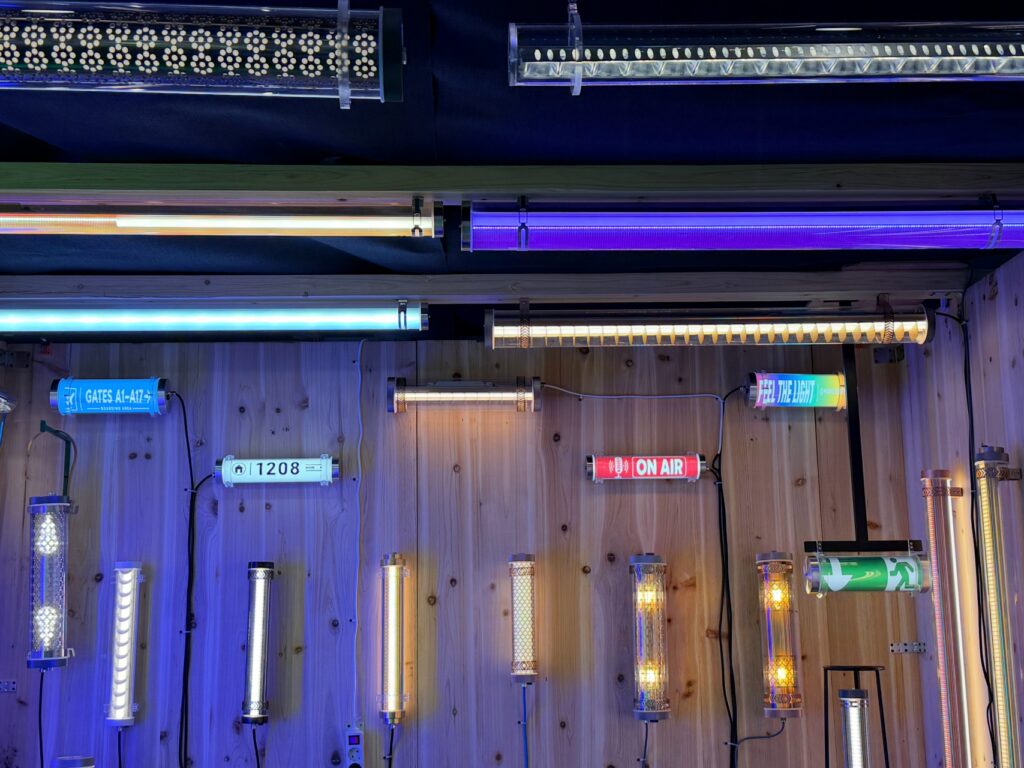
Different commercial spaces need different light distribution.
| Light Distribution | Visual Effect | Recommended Use |
|---|---|---|
| Single-side lighting | Focused wall or pathway illumination | Corridors, stairways, parking walls |
| Double-side lighting | Up-and-down wall washing effect | Hotel corridors, commercial entrances, decorative walls |
| 360° lighting | Full luminous tube effect | Feature walls, retail spaces, architectural decoration |
| Louver design | Lower glare and stronger directionality | public corridors |
| Inner mesh or perforated design | Decorative texture and visual depth | Hotels, restaurants, shops, leisure spaces |
A hotel corridor may prefer warm, double-side lighting to create atmosphere. A parking structure may require a more controlled light distribution to reduce glare. A retail façade may use 360° tubular lights as both signage support and architectural decoration.
The lighting effect should be selected according to how people move through the space, where they look, and how the wall surface interacts with light.
Dimming and Control Options for Commercial Projects
Architectural LED wall lights are often connected to a larger building control system. The control method should be confirmed before production.
| Control Type | Suitable For | Notes |
|---|---|---|
| On/off | Simple commercial areas | Lowest wiring complexity |
| 0-10V dimming | Commercial dimming systems | Requires correct dimming wiring and compatible driver |
| DALI / DALI-2 | Smart buildings and larger projects | Better for addressable lighting control |
| TRIAC dimming | Some hospitality and retrofit projects | Driver compatibility must be confirmed |
| Microwave sensor | Corridors, parking areas, utility zones | Good for motion-based switching |
| PIR sensor | Areas with clear human movement | More sensitive to line-of-sight positioning |
DALI is a dedicated protocol for digital lighting control and is standardized under IEC 62386. [3] For 0-10V systems, ANSI C137.1 specifies the 0-10V control interface method and performance requirements for LED drivers, fluorescent ballasts, and controls. [4]
In practical project work, this means the fixture supplier should confirm the driver, dimming wires, polarity, and control system compatibility before shipment.
Recommended Specifications by Application
| Application | Recommended Protection | Recommended Material | Control Option | Lighting Effect |
|---|---|---|---|---|
| Hotel corridor | IP20–IP44 depending on location | Aluminum + PMMA / PC | TRIAC, DALI, 0-10V | Warm double-side lighting |
| Parking structure | IP65–IP67 | IK10 PC tube | On/off, sensor, 0-10V | Opal or louver design |
| Outdoor walkway | IP67 | UV-resistant PC / aluminum | On/off, DALI, sensor | Single-side or 360° |
| Retail façade | IP65–IP67 | PC / PMMA / aluminum | DALI, 0-10V, RGB/RGBW option | Decorative 360° or mesh design |
| Public corridor | IP44–IP67 | PC tube | Sensor, DALI, on/off | Low-glare linear lighting |
| Coastal project | IP67 or higher | PC + stainless steel parts | On/off or DALI | Corrosion-resistant design |
Common Mistakes When Choosing Commercial LED Wall Lights
1. Choosing by Appearance Only
A wall light may look suitable in a catalog, but if the IP rating, mounting method, or driver is wrong, it may fail on site.
2. Ignoring Installation Direction
Vertical wall mounting, horizontal wall mounting, ceiling-to-wall transition, and façade installation may require different brackets or cable outlets.
3. Using Indoor Fixtures in Semi-Outdoor Areas
Covered areas are not always dry areas. Parking structures, exterior corridors, and entrance zones can still face humidity, dust, wind-driven rain, and cleaning water.
4. Not Confirming the Dimming Protocol
A DALI fixture cannot be connected in the same way as a 0-10V fixture. Incorrect control wiring can cause dimming failure or even damage.
5. Underestimating Glare
For commercial spaces where people walk, drive, or wait, glare control is part of safety and comfort.
6. Forgetting Maintenance Access
A fixture may perform well at the beginning, but if the driver, connector, bracket, or cable system is difficult to access after installation, future maintenance cost can become a serious problem.
MANI Lighting Architectural LED Wall Light Capabilities
MANI Lighting develops customized tubular and architectural LED wall lights for commercial and project-based applications.
Available customization options include:
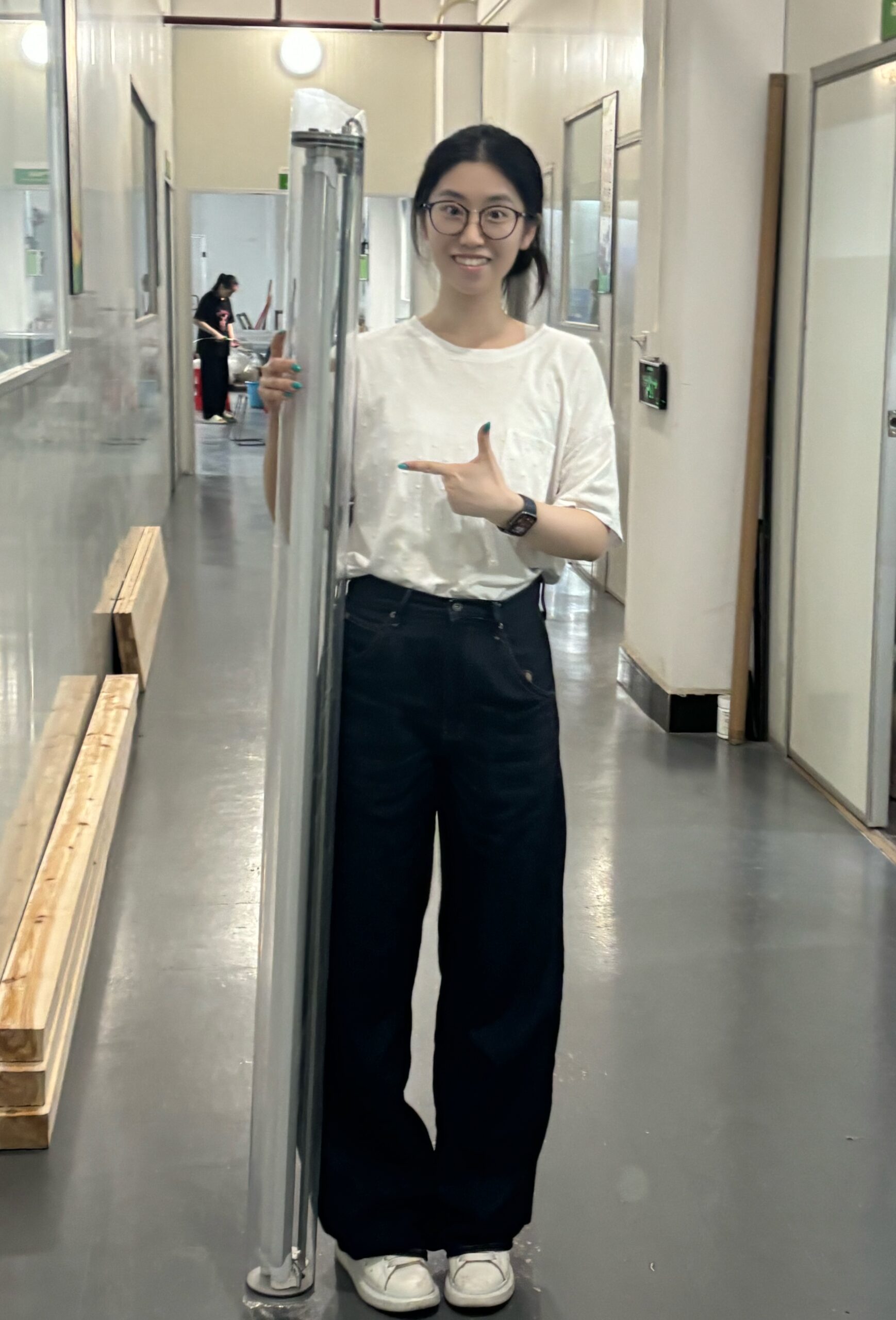
Diameter: Ø45mm, Ø70mm, Ø80mm, Ø100mm and customized sizes
Length: 300mm to 3000mm
Tube material: PC, PMMA, borosilicate glass
Light distribution: single-side, double-side, 360°
Decorative structure: louver, inner mesh, perforated metal, lens, opal diffuser
Protection: IP65, IP67, IP68, IP69K depending on design
Impact resistance: up to IK10 with PC tube structure
Control: on/off, TRIAC, 0-10V, DALI, microwave sensor, PIR sensor
Emergency option: 3W / 3h emergency lighting
Finish: anodized, painted, stainless steel, customized color
Installation: wall-mounted, ceiling-mounted, suspended, linkable version
Wiring: standard cable, quick connector, linkable connector, customized pin definition
Project support: specification review, sample confirmation, datasheet, wiring label, and installation guidance
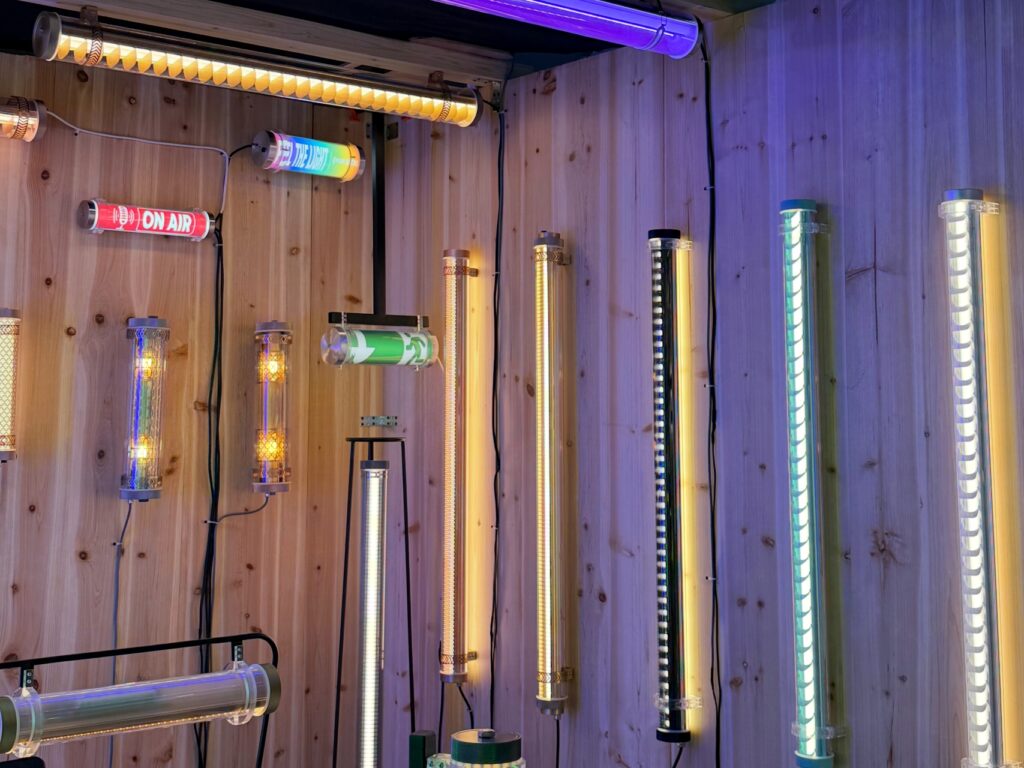
How to Specify Architectural LED Wall Lights for a Commercial Project
Before selecting a fixture, prepare the following information:
| Information Needed | Example |
|---|---|
| Installation area | Hotel corridor, parking wall, outdoor walkway, retail façade |
| Indoor or outdoor condition | Indoor, covered outdoor, exposed outdoor |
| Mounting method | Horizontal wall mount, vertical wall mount, ceiling mount |
| Required length and diameter | Ø70mm × 1200mm |
| Color temperature | 2700K, 3000K, 4000K, 5000K |
| Light distribution | Single-side, double-side, 360° |
| Control method | On/off, 0-10V, DALI, sensor |
| Protection level | IP65, IP67, IP68, IP69K |
| Impact requirement | IK08, IK10 |
| Finish requirement | Black, silver, stainless steel, RAL color |
| Quantity and project schedule | Sample, small batch, or full project order |
The more complete the project information is, the more accurate the lighting recommendation will be.
Conclusion
Architectural LED wall lights for commercial use should be selected through a project-based framework, not only by appearance or wattage. The right fixture must balance visual design, protection rating, impact resistance, control compatibility, installation method, and long-term reliability.
For commercial buildings, hotels, parking structures, public corridors, façades, and outdoor walkways, MANI Lighting can provide customized tubular LED wall lights according to real project requirements.
If you are working on a commercial lighting project, our team can help review your installation conditions and recommend a suitable architectural wall light solution.
Contact MANI Lighting for customized architectural LED wall lights for your next commercial project.
FAQ
What is the best IP rating for commercial LED wall lights?
For indoor commercial wall lights, IP20 to IP44 may be enough depending on the environment. For semi-outdoor or outdoor commercial areas, IP65 or IP67 is usually more suitable. For harsh cleaning or demanding environments, IP68 or IP69K may be considered.
Are tubular LED wall lights suitable for parking structures?
Yes. Tubular LED wall lights can be suitable for parking structures when they use durable materials, proper mounting brackets, IP protection, and impact-resistant PC tubes. IK10 PC tubular lights are often recommended for public or vehicle-adjacent areas.
Can architectural LED wall lights be customized?
Yes. MANI Lighting can customize length, diameter, material, light distribution, color temperature, finish, control method, mounting accessories, and protection level according to the project.
What is the difference between DALI and 0-10V dimming?
DALI is a digital lighting control protocol that allows more flexible and addressable control. 0-10V is an analog dimming method commonly used in commercial lighting systems. The correct driver and wiring must be confirmed before production.
References
-
[1] International Electrotechnical Commission, “Ingress Protection (IP) Ratings.”
https://www.iec.ch/ip-ratings -
[2] International Electrotechnical Commission, “IEC 62262: Degrees of protection provided by enclosures for electrical equipment against external mechanical impacts.”
https://webstore.iec.ch/en/publication/6673 -
[3] DALI Alliance, “Lighting control and IEC 62386.”
https://www.dali-alliance.org/about-us/technology.html -
[4] NEMA / ANSI C137.1, “0-10V Dimming Interface for LED Drivers, Fluorescent Ballasts, and Controls.”
https://www.nema.org/docs/default-source/standards-document-library/ansi-c137-1-2019-contents-and-scope.pdf