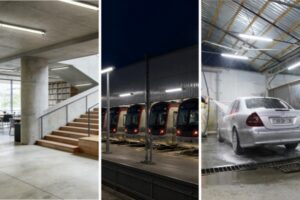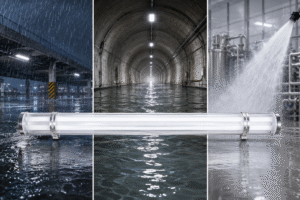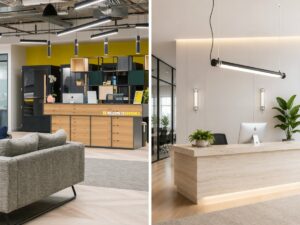
Restaurant lighting is not only about creating a pleasant atmosphere. In a commercial project, lighting affects how food looks, how guests feel, how safely staff work, how easily the space can be maintained, and how much energy the operator will spend over the life of the project.
The best restaurant lighting ideas are not single fixture ideas. They are lighting strategies matched to the actual space: dining area, bar, open kitchen, outdoor terrace, restroom, back-of-house corridor, food preparation zone, façade, and emergency route.
For lighting designers, electrical contractors, architects, distributors, facility managers, and procurement teams, the key question is not “Which lamp looks beautiful?” The better question is:
What lighting system fits the visual task, brand atmosphere, installation condition, control requirement, and operating environment of this restaurant?
This guide explains how to evaluate restaurant lighting from a project specification perspective.
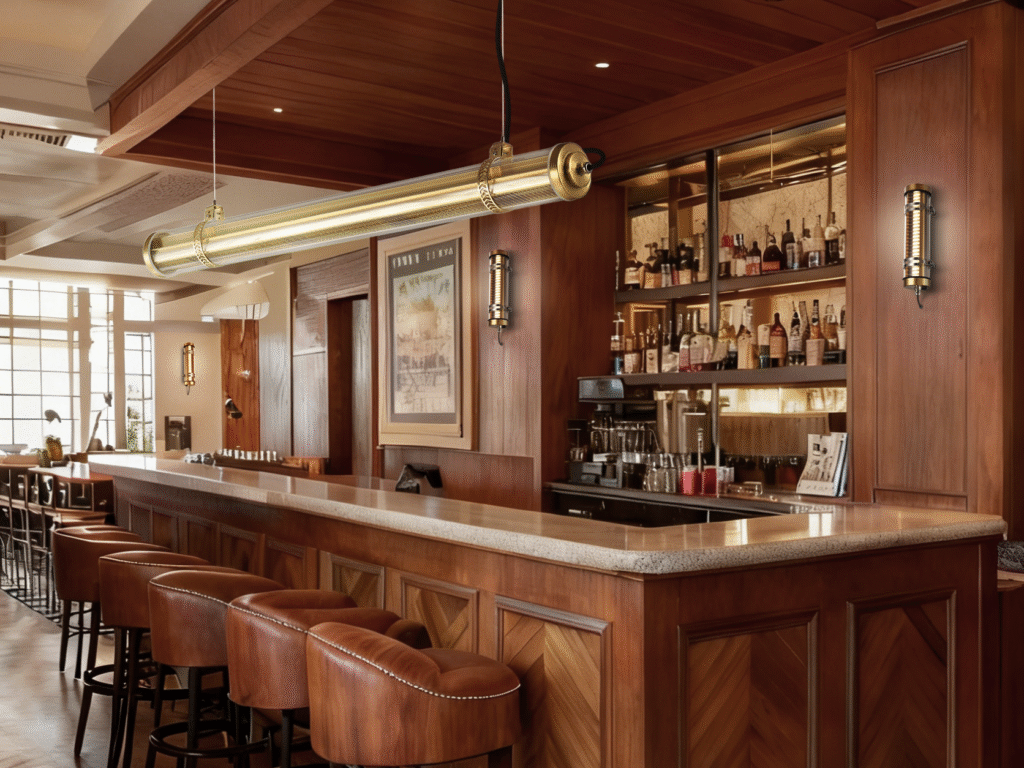
Start With Lighting Layers, Not Fixture Shapes
A common mistake in restaurant projects is selecting decorative luminaires first and solving light levels later. This often leads to glare, dark tables, over-bright circulation areas, or exposed fixtures that do not match maintenance requirements.
A restaurant usually needs four lighting layers:
| Lighting Layer | Main Purpose | Typical Application | Specification Focus |
|---|---|---|---|
| Ambient lighting | General visibility and overall mood | Dining hall, lobby, waiting area | CCT, dimming range, glare control, uniformity |
| Task lighting | Functional visibility | Cashier counter, buffet, food prep, service station | Illuminance, CRI, shadow control |
| Accent lighting | Visual focus and brand identity | Wall texture, artwork, wine display, feature ceiling | Beam angle, contrast ratio, aiming accuracy |
| Safety / service lighting | Safe operation and maintenance | Kitchen, BOH corridor, storage, emergency route | IP rating, IK rating, emergency function, easy cleaning |
Project insight: In many restaurants, the dining area is over-designed while the service areas are under-specified. A beautiful front-of-house concept can fail operationally if the kitchen pass, dishwashing area, or back corridor has poor visibility or unsuitable protection rating.
Choose CCT Based on Dining Concept and Food Presentation
Color temperature has a strong influence on how the restaurant feels. However, it should not be chosen only by preference. It should match the cuisine, interior materials, operating hours, and brand positioning.
| Restaurant Type | Recommended CCT Range | Why It Works | Notes |
|---|---|---|---|
| Fine dining | 2200K–2700K | Creates intimacy and visual warmth | Requires good dimming and high CRI |
| Casual dining | 2700K–3000K | Comfortable but still practical | Works well with wood, stone, and warm interiors |
| Café / bakery | 2700K–3500K | Warm but fresh presentation | High CRI is important for pastries and food color |
| Fast casual / food court | 3000K–4000K | Brighter, faster, and more energetic | Avoid excessive glare at ordering counters |
| Open kitchen / prep area | 4000K–5000K | Better task visibility | Must consider hygiene and protection requirements |
| Outdoor terrace | 2700K–3000K | Warm, relaxed, and visually comfortable | Use controlled optics and avoid spill light |
For most front-of-house restaurant spaces, warm white light is preferred because it supports a comfortable dining atmosphere. For exterior and terrace lighting, warmer and well-shielded light also helps reduce unnecessary glare and light trespass. DarkSky’s responsible outdoor lighting principles emphasize lighting that is useful, targeted, low level, controlled, and warm-colored. [Reference 1]
Specification tip: Do not specify CCT alone. Ask for CCT tolerance and color consistency. For project lighting, SDCM ≤3 is usually preferred when multiple luminaires are visible in the same space, especially in linear, tubular, or decorative architectural installations.
CRI Matters More Than Many Buyers Expect
In restaurant lighting, color rendering is not a luxury detail. It directly affects food presentation, skin tones, interior materials, and customer perception.
Low CRI lighting can make meat look dull, vegetables look flat, wine displays look less premium, and warm interiors look slightly gray. For dining areas, CRI ≥90 is often worth considering. For back-of-house or utility areas, CRI ≥80 may be acceptable if the project is more cost-sensitive.
| Area | Suggested CRI | Technical Reason |
|---|---|---|
| Dining table | ≥90 | Better food color, skin tone, and material appearance |
| Bar counter | ≥90 | Important for glassware, drinks, bottles, and display |
| Buffet / bakery display | ≥90 | Food color is part of the selling experience |
| Kitchen prep | ≥80 or ≥90 | Depends on food inspection and project requirements |
| Storage / BOH corridor | ≥80 | Functional visibility is usually the main priority |
Project case insight: In one restaurant retrofit scenario, the original lighting used low-cost LED strips above display shelving. The brightness was acceptable, but desserts looked less fresh and the wood finish appeared colder than intended. The solution was not simply “more lumens.” The project needed better color rendering, warmer CCT alignment, and controlled linear light distribution.
Control Glare Before Increasing Lumens
Restaurant lighting often fails because the design tries to solve darkness by adding more wattage. In reality, many spaces need better optical control rather than more lumens.
Glare problems usually appear in four places:
Direct Glare From Visible LED Sources
This happens when LED points are exposed in low mounting positions, under shelves, or near eye level.
Reflected Glare From Tables and Bar Tops
Glossy stone, glass, metal, and polished wood can reflect light directly into guests’ eyes.
Over-Bright Circulation Areas
If walkways are much brighter than dining tables, the room can feel visually unbalanced.
Poorly Aimed Accent Lighting
Narrow-beam spotlights can create harsh shadows on faces or uncomfortable highlights.
| Problem | Better Specification Approach |
|---|---|
| Dining table feels dark | Improve beam placement and contrast, not only wattage |
| Guests complain about glare | Use diffused optics, louver, shielding, or indirect light |
| Bar counter has harsh reflections | Reduce direct angle and use linear controlled light |
| Open ceiling looks messy | Use continuous architectural lighting with clean cable routing |
| Outdoor terrace feels overlit | Use lower output, warmer CCT, and targeted distribution |
For tubular LED lighting, glare control can be improved through opal diffusers, internal louvers, perforated structures, indirect mounting, or 360° decorative distribution depending on the project concept.
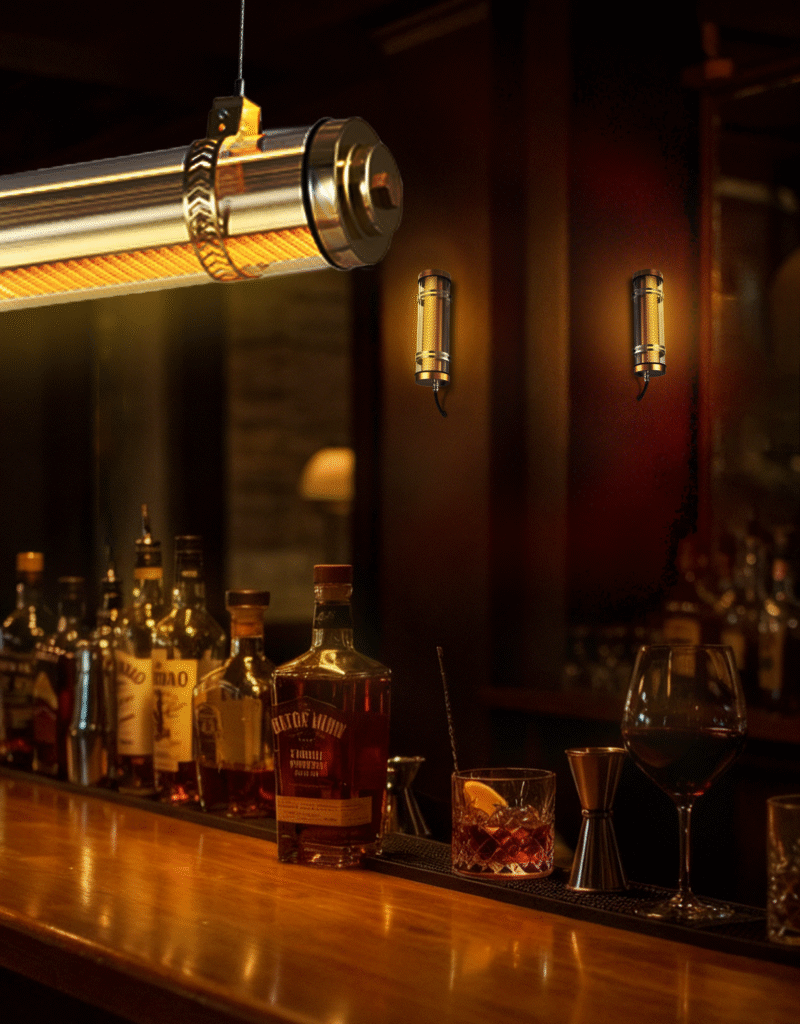
Match IP Rating to the Real Restaurant Environment
Not every restaurant area needs a high IP rating. But some areas absolutely do.
IP rating should be selected according to dust, moisture, cleaning method, grease exposure, and outdoor conditions. IEC explains that IP ratings classify the resistance of an enclosure against the intrusion of dust or liquids. [Reference 2]
| Restaurant Area | Typical Risk | Suggested IP Consideration |
|---|---|---|
| Dining area | Low moisture, cleaning by cloth | IP20–IP40 may be enough |
| Restroom | Humidity and occasional splashing | IP44 or higher depending on location |
| Kitchen pass | Heat, steam, grease | IP65 often preferred |
| Dishwashing area | Moisture and cleaning spray | IP65 or higher |
| Outdoor terrace | Rain, dust, insects | IP65–IP67 depending on exposure |
| Coastal restaurant | Salt air, humidity, corrosion | IP65–IP67 plus corrosion-resistant materials |
| Food processing / heavy washdown | High-pressure cleaning | IP69K may be required |
Important insight: IP65 does not automatically mean suitable for every restaurant application. A kitchen with grease vapor, heat, and frequent cleaning requires attention to seals, materials, cable glands, end caps, and driver location. For exposed outdoor or coastal projects, corrosion resistance may be as important as waterproofing.
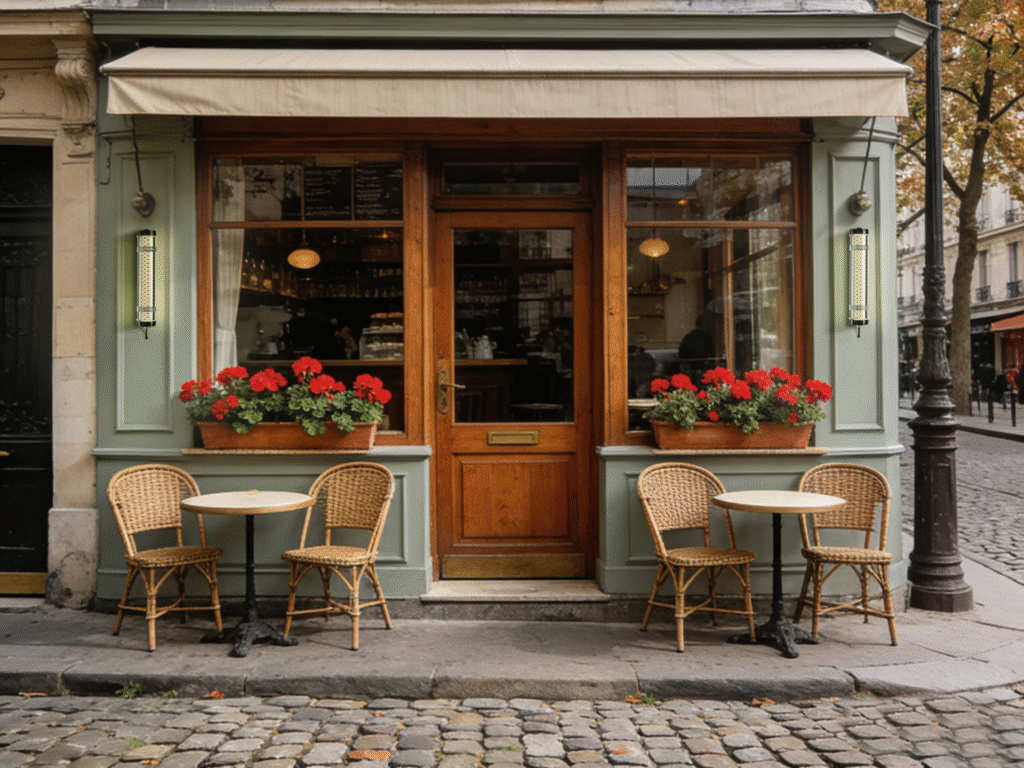
Do Not Ignore IK Rating in Public and Service Areas
IK rating is often overlooked in restaurant lighting, but it matters in areas exposed to impact, cleaning equipment, carts, luggage, or public contact. IEC 62262 defines the degrees of protection provided by enclosures for electrical equipment against external mechanical impacts. [Reference 3]
| Area | Impact Risk | Suggested IK Consideration |
|---|---|---|
| Fine dining ceiling | Low | IK rating may be less critical |
| Corridor / restroom | Medium | IK07–IK08 can be useful |
| Outdoor terrace | Medium | Consider IK08–IK10 |
| Parking-connected restaurant entrance | High | IK10 preferred |
| BOH corridor / storage | High | IK08–IK10 recommended |
| Industrial kitchen / food service facility | High | IK10 often preferred |
For tubular luminaires, PC tubes are usually more suitable when high impact resistance is required. Glass tubes may offer excellent chemical resistance and premium transparency, but impact resistance is more limited compared with PC.
Select the Right Dimming and Control Strategy
Restaurant lighting changes throughout the day. Breakfast, lunch, dinner, cleaning, private events, and closing time may all require different scenes.
A good control strategy improves guest experience and reduces energy use. ENERGY STAR notes that lighting is a significant restaurant energy user, averaging 13% of a restaurant’s energy breakdown, and that lighting is a good starting point for an efficiency upgrade. [Reference 4]
| Control Method | Best For | Advantages | Limitation |
|---|---|---|---|
| ON/OFF | BOH, storage, simple projects | Low cost, easy installation | No scene flexibility |
| TRIAC dimming | Small dining areas, retrofit | Simple wall dimmer control | Compatibility must be checked |
| 0–10V dimming | Commercial dining, linear lighting | Stable dimming for zones | Requires control wiring |
| DALI / DALI-2 | Larger restaurants, hotel restaurants | Addressable scenes and zoning | Higher system planning requirement |
| Motion sensor | Restroom, corridor, storage | Saves energy in low-occupancy areas | Not ideal for main dining ambience |
| Emergency function | Exit routes, BOH, public areas | Supports safety compliance | Battery and testing access required |
DALI is an industry-standardized lighting control protocol specified in the multi-part international standard IEC 62386. DALI-2 is the certification program based on the latest version of the DALI protocol. [Reference 5]
ANSI C137.1 specifies the 0–10V control interface method and performance requirements for dimmable LED drivers, fluorescent ballasts, and dimming control units. [Reference 6]
Specification tip: Always confirm the control system before ordering luminaires. A luminaire with a dimmable driver is not enough. The driver, dimmer, control wiring, dimming curve, minimum dimming level, flicker performance, and commissioning method must be compatible.
Restaurant Lighting Ideas by Application Area
Dining Area: Comfortable, Warm, and Low-Glare
Use warm CCT, high CRI, and layered lighting. Avoid lighting only from the ceiling grid. Wall washing, indirect tubular lighting, pendant accents, and concealed linear lighting can create depth.
Best idea: Use architectural tubular lights as visual lines along walls, booths, or ceilings to support the interior rhythm without making the fixture feel too decorative or too industrial.
Bar Area: Contrast and Material Rendering
Bars need stronger visual focus. Bottles, glass, metal, stone, and wood surfaces require good color rendering and controlled reflections.
Best idea: Use linear or tubular lighting under shelves, behind bottle displays, or above the counter with careful shielding.
Open Kitchen: Clean, Durable, and Serviceable
An open kitchen needs brighter task lighting, but it is still visible to guests. The luminaires must look clean and be easy to maintain.
Best idea: Use IP-rated tubular luminaires with opal diffusion or controlled optics to provide uniform working light while keeping a professional appearance.
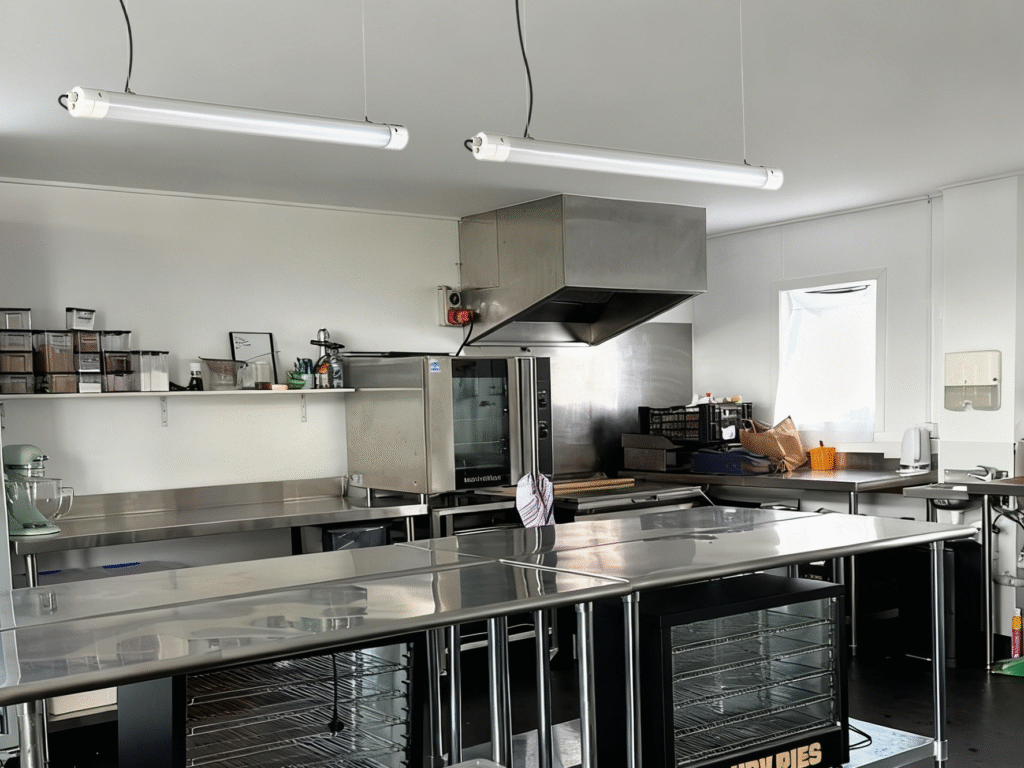
Outdoor Terrace: Warm, Controlled, and Weather-Resistant
Outdoor restaurant lighting should not spill light into neighboring properties or create harsh glare.
Best idea: Use IP65–IP67 luminaires, warm CCT, shielded distribution, and dimming schedules.
Back-of-House: Practical and Reliable
BOH areas need visibility, durability, and easy maintenance more than decorative appearance.
Best idea: Use industrial tri-proof tubular lights with appropriate IP/IK rating, emergency options, and sensor control where occupancy is intermittent.
Practical Restaurant Lighting Specification Checklist
Before selecting luminaires, confirm the following:
Application area: dining, bar, kitchen, terrace, restroom, BOH, façade, corridor
Mounting method: ceiling, wall, pendant, recessed, surface-mounted, vertical, horizontal
Required dimensions: diameter, length, installation clearance, cable entry position
Optical requirement: diffused, direct, indirect, 360°, single-sided, double-sided, louvered, accent
CCT: 2700K, 3000K, 4000K, or tunable white
CRI: ≥80 or ≥90
Power and lumen output: define both wattage and required delivered lumens
IP rating: selected according to moisture, dust, cleaning, and outdoor exposure
IK rating: selected according to impact risk
Material: PC, PMMA, glass, aluminum, stainless steel
Control method: ON/OFF, TRIAC, 0–10V, DALI, sensor, emergency
Driver brand and location: confirm electrical compatibility and maintenance access
Local compliance: confirm electrical, safety, and project specification requirements
Packaging and replacement strategy: important for project quantity and future maintenance
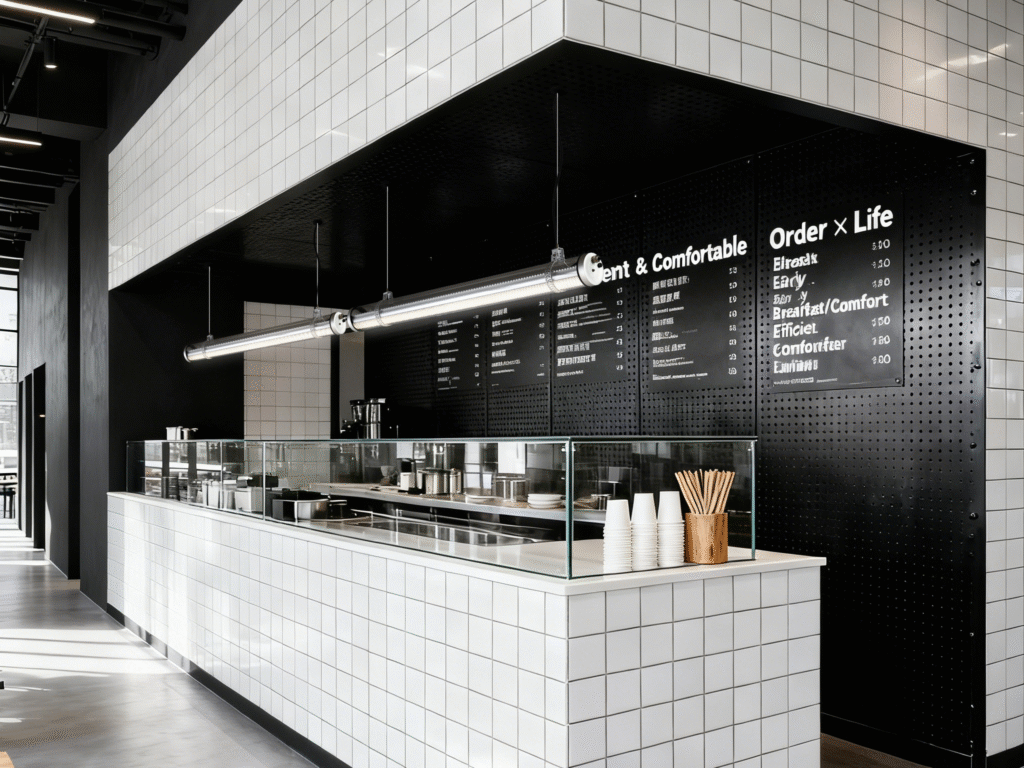
What Is the Best Restaurant Lighting Idea?
The best restaurant lighting idea is not one style. It is a coordinated specification strategy.
A fine dining restaurant may need warm dimmable lighting, high CRI, low glare, and discreet architectural fixtures. A fast-casual restaurant may need brighter, more uniform lighting with durable commercial luminaires. A coastal outdoor restaurant may need IP-rated, corrosion-resistant, warm-colored lighting with careful glare control. A kitchen or BOH area may need industrial tri-proof tubular lights with higher IP/IK ratings and practical maintenance access.
For restaurant projects, the most reliable lighting solution usually comes from balancing five factors:
1. Atmosphere — CCT, dimming, contrast, and fixture appearance
2. Visual quality — CRI, glare control, beam distribution, and uniformity
3. Environment — IP rating, IK rating, materials, cleaning, and corrosion risk
4. Installation — mounting method, wiring, driver position, and maintenance access
5. Operation — control scenes, sensors, emergency function, and energy use
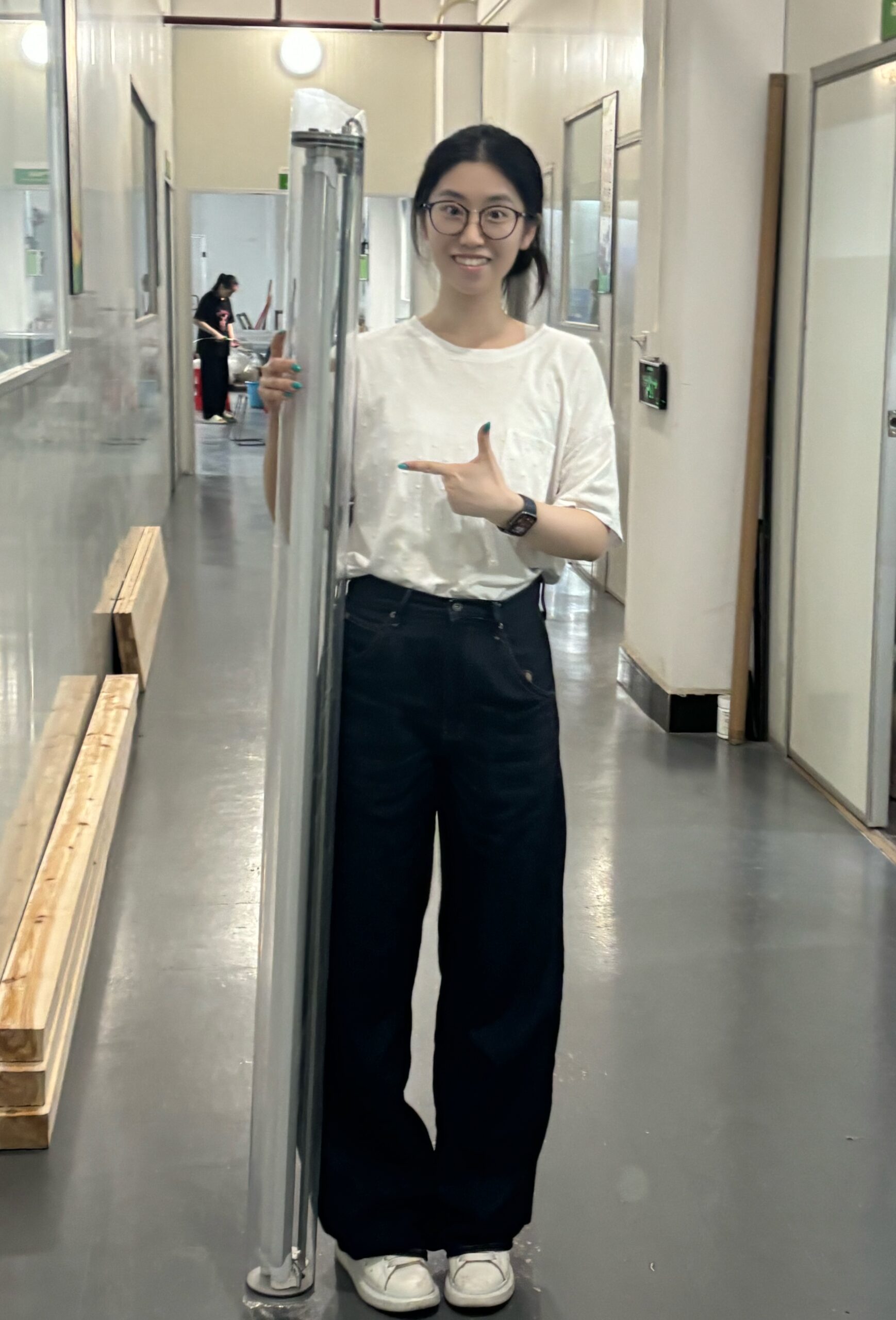
If you can provide the application area, preferred size, wattage, mounting method, control method, IP/IK requirement, and environmental conditions, MANI Lighting can help evaluate a more suitable tubular LED lighting solution for the project.
References
- DarkSky International, “Five Principles for Responsible Outdoor Lighting.” https://darksky.org/resources/guides-and-how-tos/lighting-principles/
- IEC, “Ingress Protection (IP) Ratings.” https://www.iec.ch/ip-ratings
- IEC 62262, “Degrees of protection provided by enclosures for electrical equipment against external mechanical impacts.” https://webstore.iec.ch/en/publication/6673
- ENERGY STAR, “Small Business: Restaurants.” https://www.energystar.gov/buildings/resources-audience/small-biz/restaurants
- DALI Alliance, “DALI-2 and IEC 62386.” https://www.dali-alliance.org/dali/
- ANSI / NEMA, “ANSI C137.1 Lighting Systems — 0–10V Dimming Interface.” https://webstore.ansi.org/standards/nema/ansic1372022