Choosing garage lights is not only about brightness. In parking garages, underground car parks, residential buildings, hotels, offices, and commercial facilities, lighting needs to support safety, visibility, energy saving, security cameras, and long-term reliability.
A motion sensor garage light detects movement from people or vehicles and automatically adjusts the light output. When movement is detected, the light turns on or increases to full brightness. When the area is empty, it dims down to a standby level or turns off according to the project setting.
In my experience, the best garage lighting solution is usually not “lights off when nobody is there.” A better solution is dim-to-bright control. The garage keeps a basic light level for safety, and the lights become brighter when cars or pedestrians enter the area.
What Is a Motion Sensor Garage Light?
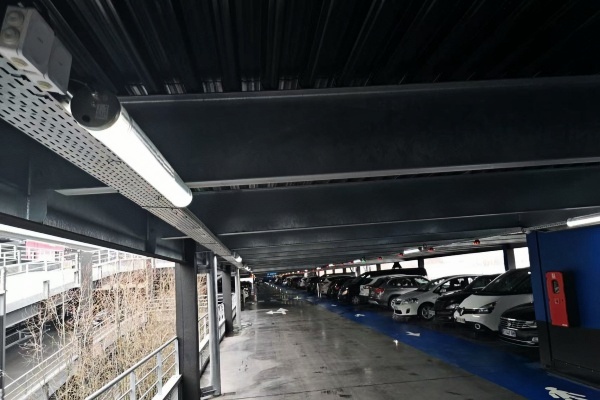
A motion sensor garage light is a lighting fixture with a built-in or external sensor. The sensor detects movement and sends a signal to the LED driver. Then the light changes its brightness automatically.
For example, in an empty parking area, the lights may stay at 20% or 30% brightness. When a car drives in, the nearby lights increase to 100% brightness. After the car leaves and no movement is detected, the lights return to the standby level.
This type of lighting is useful because it saves energy without making the garage feel completely dark or unsafe.
For parking garages, I usually recommend LED tri-proof lights or tubular LED lights with sensor control, because these fixtures are durable and suitable for humid, dusty, and high-traffic environments.
How Does a Motion Sensor Garage Light Work?
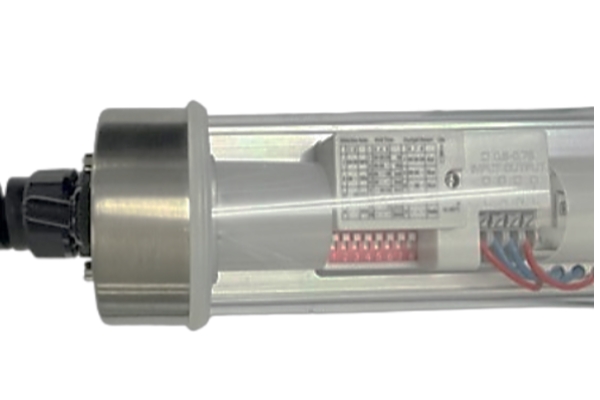
The working process is simple, but the settings are very important.
Basic Working Process
- Standby Mode: The garage is empty, and the light stays at a low brightness level.
- Motion Detection: A car or person enters the detection area.
- Full Brightness: The light increases to 100% brightness.
- Hold Time: The light stays bright for a set time after the last movement.
- Dim Down: If no new movement is detected, the light dims back to standby level.
The key point is that the light should respond smoothly and safely, not suddenly turn off while people are still using the space.
Table: Common Sensor Settings for Parking Garages
| Setting | What It Means | Common Garage Setting |
|---|---|---|
| Detection Area | How far and how wide the sensor can detect movement | 50%–100% |
| Hold Time | How long the light stays bright after movement stops | 60–180 seconds |
| Standby Dimming Level | The brightness when no movement is detected | 10%–30% |
| Standby Period | How long the light stays dim before turning off | Permanent or project-based |
For most parking garage projects, I do not suggest using a very short hold time. If the light dims too quickly while a driver is parking or a pedestrian is walking, the experience will be uncomfortable and unsafe.
PIR Sensor or Microwave Sensor: Which Is Better for Garage Lighting?
There are two common sensor types used in garage lighting: PIR sensors and microwave sensors.
PIR Sensor
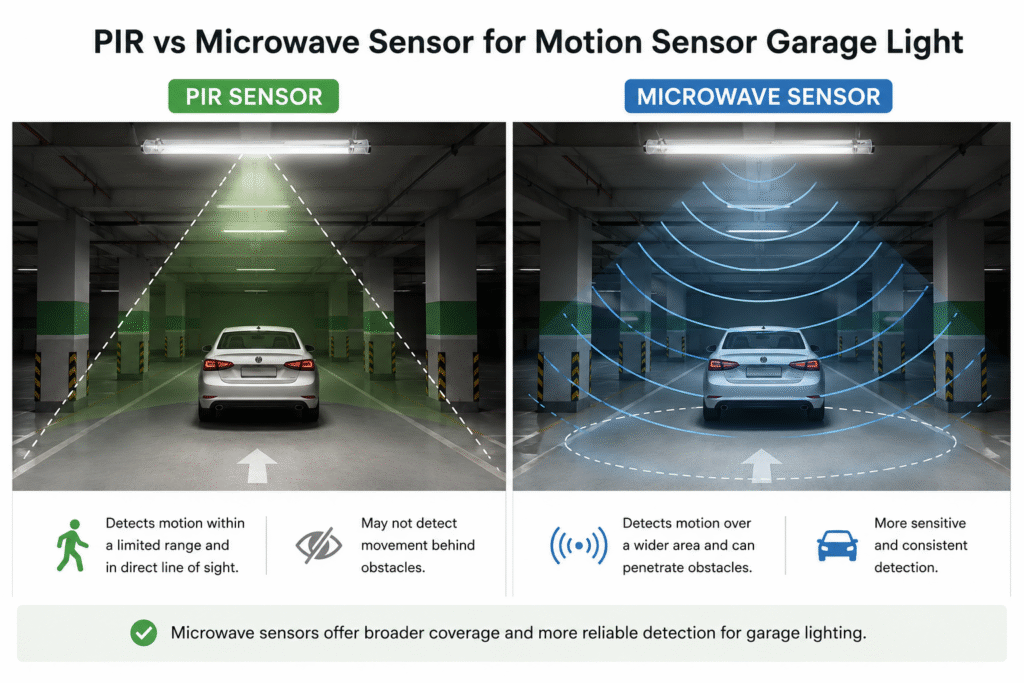
A PIR sensor detects changes in infrared radiation caused by temperature differences between a moving person or object and the surrounding environment.[2] It works well in small rooms, offices, toilets, and areas with a clear line of sight.
However, in parking garages, PIR sensors may not always be the best choice. Cars do not always create the same heat signal as people, and high ceilings or pillars can reduce the detection effect.
Microwave Sensor
A microwave sensor detects movement by sending out microwave signals and reading the reflected signal changes.[3] It is usually more sensitive and can detect both people and vehicles more reliably.
For most commercial parking garages and underground car parks, I usually recommend microwave sensors because they are more suitable for vehicle movement, larger spaces, and complex layouts.
However, microwave sensors need proper adjustment. If the sensitivity is too high, they may detect movement outside the target area, such as behind a thin wall or nearby driveway.
Table: PIR vs. Microwave Sensor for Garage Lighting
| Item | PIR Sensor | Microwave Sensor |
|---|---|---|
| Detection Method | Detects body heat | Detects movement by reflected signals |
| Best For | Small rooms, clear spaces | Garages, corridors, warehouses |
| Vehicle Detection | Not always reliable | More reliable |
| Ceiling Height | Sensitive to mounting height | Better for higher ceilings |
| Main Risk | May miss movement | May be too sensitive if not adjusted |
Choosing garage lights is not only about brightness. In parking garages, underground car parks, residential buildings, hotels, offices, and commercial facilities, lighting needs to support safety, visibility, energy saving, security cameras, and long-term reliability.
Why Use Motion Sensor Lights in a Parking Garage?
Motion sensor lighting is not only for saving electricity. It also improves the user experience and helps make the garage safer.
1. Energy Saving
Parking garages often operate for long hours, sometimes 24 hours a day. If all lights stay at full power all the time, the energy cost can be very high.
With motion sensor control, lights can stay at a lower standby brightness when there is no traffic. This can reduce unnecessary power consumption while still keeping the space visible.[1]
In many garage projects, dim-to-bright lighting is a better balance than simple on/off control.
2. Better Safety for Drivers and Pedestrians
A garage should not feel dark or unsafe. When people walk through the area or cars enter the driveway, the lights should brighten quickly and provide clear visibility.
This is especially important for:
- Entrances and exits
- Ramps
- Pedestrian walkways
- Elevator halls
- Stairwell entrances
- Corners and blind spots
3. Better Support for Security Cameras
Security cameras need enough light to capture clear images. If the garage becomes completely dark, CCTV performance may be affected.
A standby dimming level can help the camera keep basic visibility. When movement is detected, the light becomes brighter and the camera can capture clearer details.
4. Longer Fixture Life
LED lights already have a long lifespan, but running at full power all the time still creates heat and stress for the driver and LED chips. Sensor dimming helps reduce unnecessary full-load operation, which can support longer service life and lower maintenance frequency.
What Specifications Should You Check Before Buying?
When choosing a motion sensor garage light, I suggest checking more than just wattage and lumen output. The sensor settings and fixture durability are also very important.
Important Specifications
| Specification | Recommendation for Garage Lighting |
|---|---|
| Sensor Type | Microwave sensor is usually preferred |
| Standby Level | 10%–30%, depending on the area |
| Hold Time | 60–180 seconds |
| IP Rating | IP65[4] minimum for most garages |
| IK Rating | IK08[5] or higher recommended |
| CCT | 5000K or 6000K is commonly used |
| CRI | CRI80 is usually enough |
| Emergency Option | 3-hour emergency backup if required |
| Mounting | Ceiling, wall, suspended, or surface mounted |
For general parking areas, 5000K is a comfortable and practical choice. For some commercial or security-focused areas, 6000K may also be used.
I do not suggest choosing a garage light only because it is cheap. In parking garages, replacement labor and maintenance cost can be higher than the fixture price itself.
Why Are LED Tri-Proof Lights Suitable for Garage Sensor Lighting?
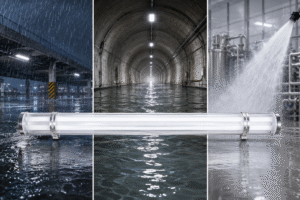
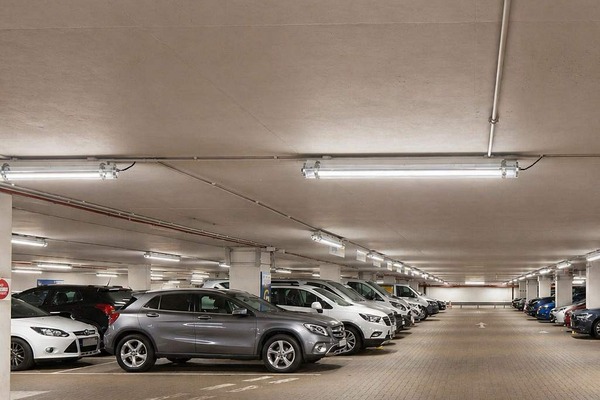
A parking garage may look like an indoor space, but the environment is not always clean or easy. There may be moisture, dust, exhaust fumes, vibration, and occasional impact.
That is why LED tri-proof lights are commonly used in garages.
Main Advantages of LED Tri-Proof Lights
LED tri-proof lights are designed to be:
- Waterproof
- Dustproof
- Corrosion-resistant
- Impact-resistant[5]
- Easy to install
- Suitable for long operating hours
For underground car parks, I usually suggest choosing at least IP65[4]. If the area requires stronger washing, humid protection, or more demanding durability, higher protection levels can be considered.
A good garage lighting fixture should not only be bright. It should also survive the garage environment for many years.
Common Mistakes to Avoid
I have seen some garage lighting projects fail not because the lights were bad, but because the settings or layout were not suitable.
Mistake 1: Setting Standby Brightness to 0%
Turning the lights completely off may save more energy, but it can make the garage feel unsafe. It may also affect CCTV cameras and create a bad user experience when lights turn on one by one.
For many commercial garages, I prefer a low standby level instead of full off.
Mistake 2: Setting the Hold Time Too Short
A very short hold time, such as 10 or 20 seconds, may cause the light to dim while someone is still parking, unloading items, or walking.
For parking areas, a longer hold time is usually safer and more comfortable.
Mistake 3: Using the Same Setting for the Whole Garage
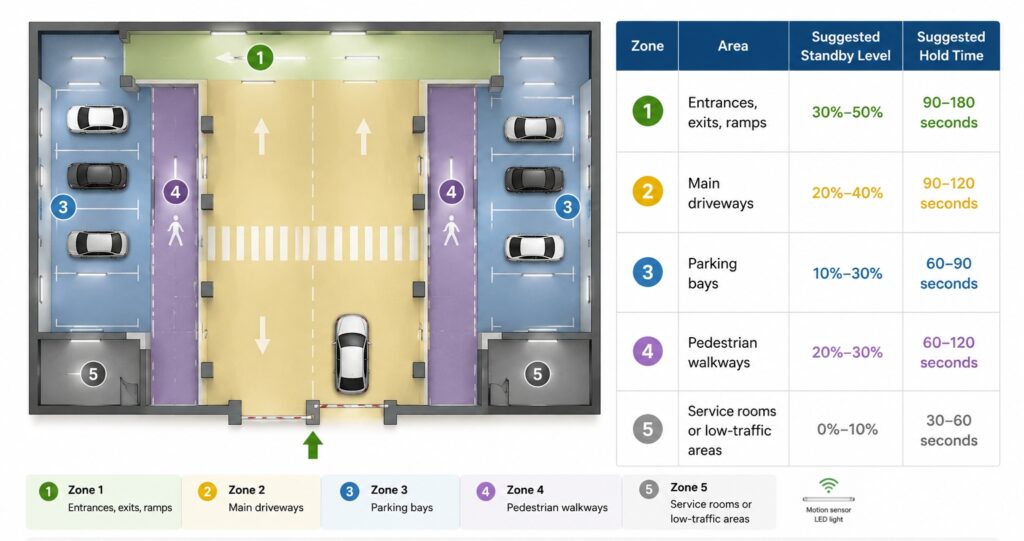
A garage has different zones. The entrance, ramp, driveway, parking bay, and service room do not need the same lighting setting.
Mistake 4: Ignoring Emergency Lighting
Motion sensor lighting should not replace emergency lighting. Escape routes, stairwells, and emergency areas may need dedicated emergency fixtures or battery backup according to local project requirements.[6]
Sensor control is for energy saving and comfort, but emergency lighting must be planned separately and carefully.
How to Plan a Motion Sensor Garage Lighting Layout
A good lighting layout should divide the garage into different zones. This makes the system safer, more efficient, and easier to control.
Table: Suggested Lighting Zones for Parking Garages
| Zone | Area | Suggested Standby Level | Suggested Hold Time |
|---|---|---|---|
| Zone 1 | Entrances, exits, ramps | 30%–50% | 90–180 seconds |
| Zone 2 | Main driveways | 20%–40% | 90–120 seconds |
| Zone 3 | Parking bays | 10%–30% | 60–90 seconds |
| Zone 4 | Pedestrian walkways | 20%–30% | 60–120 seconds |
| Zone 5 | Service rooms or low-traffic areas | 0%–10% | 30–60 seconds |
For high-risk or high-traffic areas, I prefer a higher standby brightness and longer hold time. For low-traffic areas, the standby level can be lower.
The goal is not to make every light behave the same. The goal is to make each area safe, comfortable, and energy-efficient.
Conclusion
A motion sensor garage light can help reduce energy consumption, improve safety, and make parking garages easier to manage. But the final result depends on choosing the right sensor, proper dimming settings, suitable hold time, and durable fixtures.
For most parking garage projects, I would suggest using LED tri-proof lights with microwave sensor control, especially in underground car parks, commercial buildings, hotels, offices, and residential parking areas.
The best garage lighting solution is not always the brightest one. It is the one that gives enough light at the right time, in the right area, with long-term reliability.
If you are planning a parking garage lighting project and need help choosing sensor settings, fixture structure, or lighting layout, you can contact us for a suitable solution.
References
- U.S. Department of Energy, Demonstration Assessment of LED Parking Structure Lighting .
- Panasonic Industry, Panasonic PIR Motion Sensor FAQs .
- STEINEL, Sensor Technologies .
- International Electrotechnical Commission, Ingress Protection Ratings and IEC 60529 .
- International Electrotechnical Commission, IEC 62262: Degrees of Protection Against External Mechanical Impacts .
- BSI, BS EN 1838:2024 — Emergency Lighting for Buildings .