Introduction
If you’ve ever looked toward a luminaire and felt uncomfortable even though the overall lighting level seemed appropriate, you’ve experienced discomfort glare.
In professional lighting design, this phenomenon is evaluated using the Unified Glare Rating (UGR), one of the most widely adopted metrics for assessing visual comfort in indoor environments. Standards such as EN 12464-1 recommend maximum UGR values for offices, classrooms, hospitals and many commercial spaces because excessive glare can reduce productivity, increase eye fatigue and negatively affect user experience.
Many articles explain what UGR is or provide recommended UGR values, but they rarely discuss how luminaire design actually influences UGR.
As a lighting manufacturer, we often receive questions such as:
“How can we reduce the UGR value without significantly reducing light output?”
The answer lies in optical design.
In this article, we’ll explain the design principles behind UGR and show how optical structures, diffuser materials and luminous surface design work together to improve visual comfort.
Understanding What Affects UGR
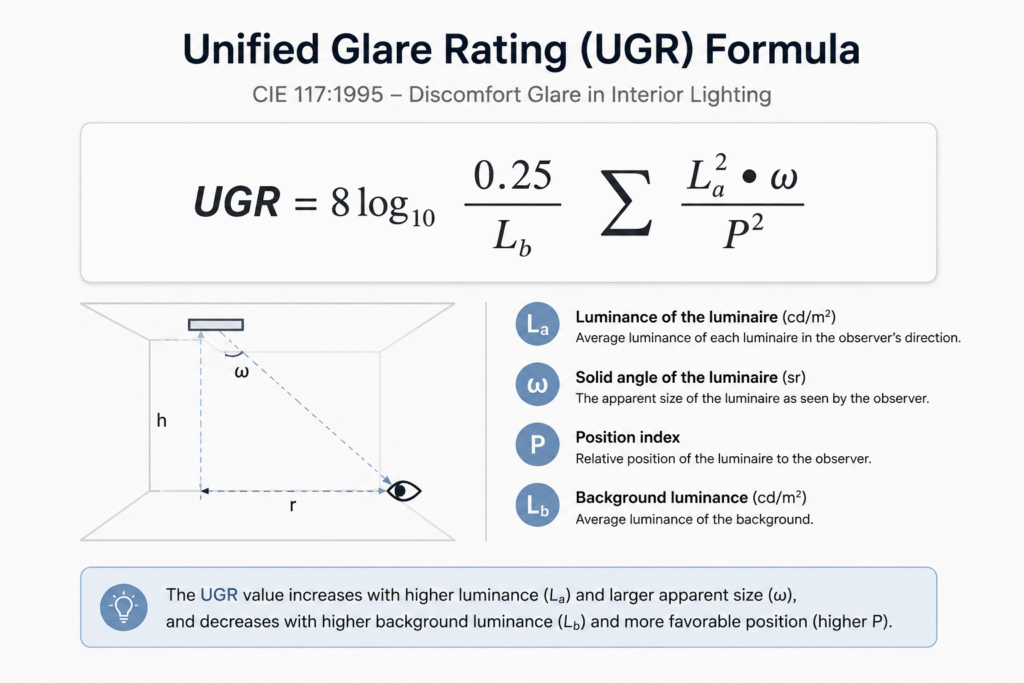
According to the CIE Unified Glare Rating equation, four parameters determine the final UGR value:
- La – Luminance of the visible emitting surface
- ω – Apparent solid angle of the luminous surface
- Lb – Background luminance
- P – Guth position index
Among these variables, background luminance (Lb) and observer position (P) are mainly determined by the room layout and installation conditions.
For luminaire manufacturers, the parameters that can actually be optimized during product development are:
- Surface luminance (La)
- Visible emitting area (ω)
These two factors form the basis of almost every low-glare luminaire.
Reduce Surface Luminance Without Sacrificing Illuminance
The first design strategy is reducing the luminance of the emitting surface.
A lower surface luminance generally leads to a lower UGR because the observer perceives the light source as less intense.
There are two common approaches.
The first is reducing the reflected brightness of the optical system by using lower-reflectance coatings or optical components. Although this can effectively reduce glare, it may also decrease luminaire efficiency because part of the light is absorbed instead of reflected.
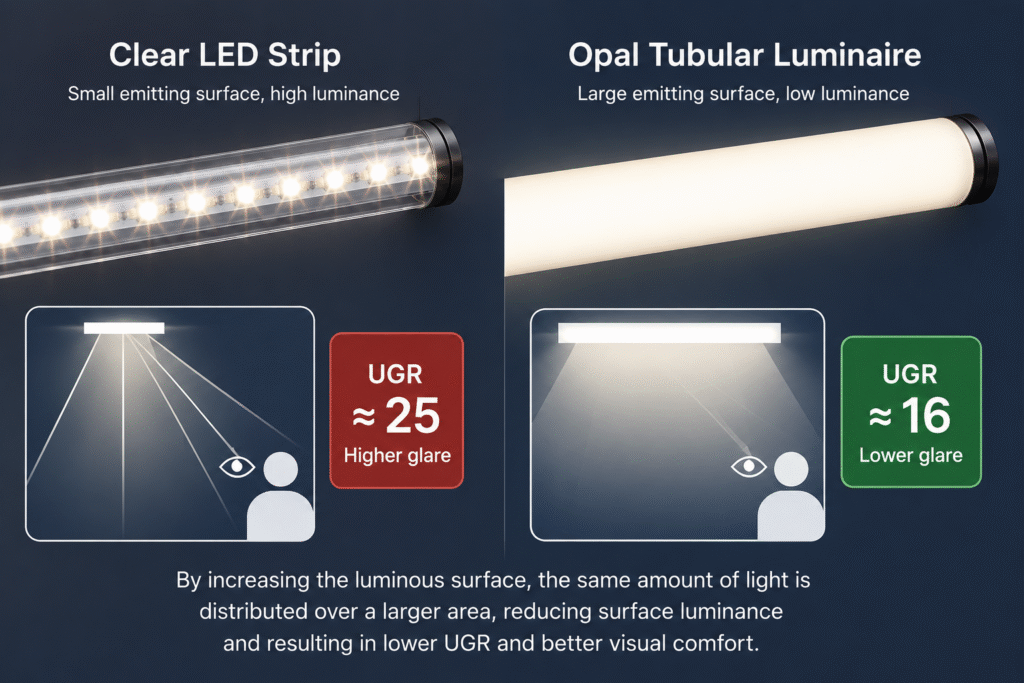
The second—and often more practical—approach is increasing the emitting surface area.
Instead of concentrating the same luminous flux into a small area, the light is distributed over a larger luminous surface. This lowers surface luminance while maintaining similar illuminance levels on the working plane.
For tubular luminaires, this can be achieved by using opal diffusers, larger tube diameters, or full-length illuminated surfaces instead of exposing individual LED packages.
Reduce the Visible Light Source
Besides luminance, another critical parameter is the apparent solid angle (ω).
Simply put, this represents how much of the light source is visible to the observer.
If less of the luminous surface can be seen, the apparent solid angle becomes smaller, resulting in a lower UGR value.
This principle explains why many architectural luminaires hide the LED source instead of exposing it directly.
In tubular lighting, designers often achieve this using:
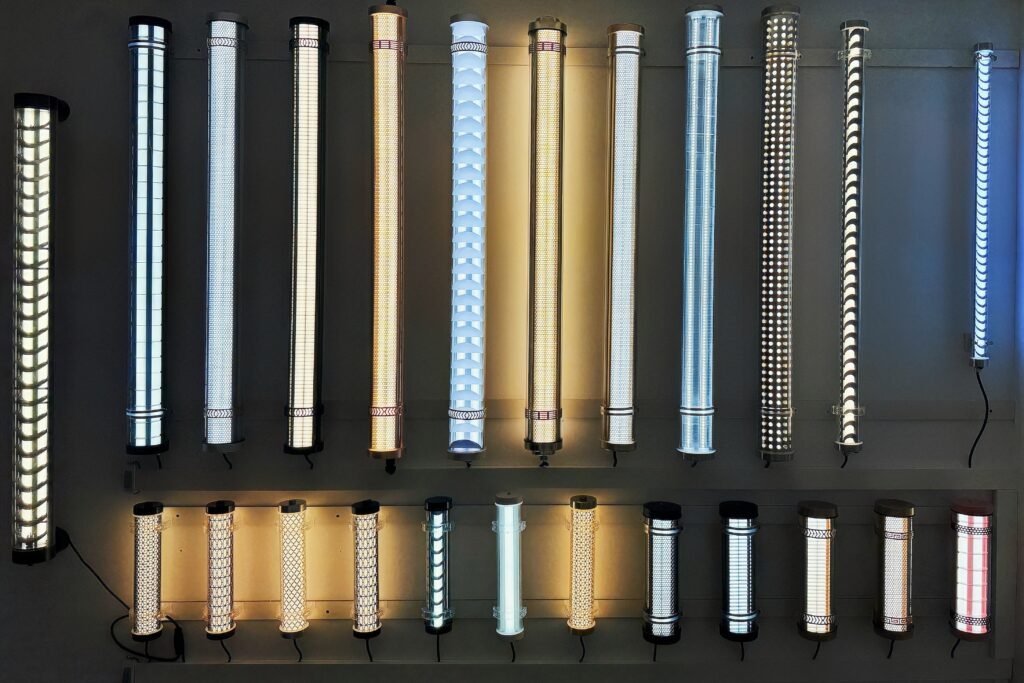
- Internal aluminum louvers
- Honeycomb optical structures
- Decorative mesh inserts
- Perforated metal sleeves
- Micro-prismatic diffusers
These components partially block direct views of the LED while allowing useful light to exit the luminaire.
The Importance of Shielding Angle
Shielding angle is one of the most effective methods of reducing glare.
A larger shielding angle means the LED light source is positioned deeper behind the optical opening, making it more difficult for occupants to look directly at the brightest part of the luminaire.
Although increasing the shielding angle may slightly narrow the light distribution, it significantly improves visual comfort in environments where people spend long periods under artificial lighting.
For architectural tubular luminaires, shielding can be achieved through carefully designed optical inserts rather than simply recessing the fixture.
This allows the luminaire to maintain its distinctive cylindrical appearance while still delivering excellent glare control.
Optical Structures Play a Bigger Role Than Many People Realize
Modern anti-glare luminaires rely on more than just diffusers.
Different optical structures produce different lighting characteristics.
| Optical Structure | Primary Function | Typical Effect on UGR |
|---|---|---|
| Opal Diffuser | Increase luminous surface | Reduce surface luminance |
| Honeycomb Insert | Block high-angle light | Reduce visible light source |
| Aluminum Louver | Control light direction | Improve visual comfort |
| Perforated Metal Sleeve | Partially conceal LEDs | Lower apparent brightness |
| Decorative Mesh | Diffuse direct visibility | Enhance visual comfort |
UGR Is Not Determined by the Luminaire Alone
A common misconception is that every luminaire has a fixed UGR value.
In reality, UGR describes the lighting installation, not just the product itself.
The final glare level also depends on:
- Ceiling height
- Luminaire spacing
- Viewing direction
- Room reflectance
- Mounting height
- Background brightness
This is why manufacturers publish UGR tables based on standardized room conditions rather than assigning a single UGR value to a luminaire.
Professional lighting calculations remain essential for achieving the desired visual comfort in real projects.
Conclusion
Reducing UGR is not about adding a single anti-glare component. It is the result of balancing surface luminance, visible light source, shielding angle, and optical structures to create a comfortable visual environment.
For architectural tubular lighting, carefully selected diffusers, louvers, honeycomb inserts, perforated metal sleeves, and other internal optical elements can significantly improve glare performance while preserving the fixture’s aesthetic design and lighting efficiency.
Rather than pursuing the lowest possible UGR, successful lighting design aims to achieve the right balance between visual comfort, illuminance, efficiency, and architectural appearance for each specific application.
FAQ
What is considered a good UGR value?
For most offices, schools, and commercial spaces, a UGR of 19 or below is generally recommended according to EN 12464-1.
Does an opal diffuser always reduce UGR?
An opal diffuser typically lowers surface luminance by increasing the apparent emitting area, which helps reduce glare. However, the final UGR also depends on the luminaire’s optical structure and installation conditions.
Why can two tubular luminaires with the same lumen output have different UGR values?
Because UGR is influenced by many factors beyond lumen output, including the visible emitting surface, shielding angle, diffuser design, optical components, room geometry, and viewing direction.
References
- International Commission on Illumination (CIE). CIE 117:1995 — Discomfort Glare in Interior Lighting. Available at: CIE 117:1995 .
- International Commission on Illumination (CIE). CIE 190:2010 — Calculation and Presentation of Unified Glare Rating Tables for Indoor Lighting Luminaires. Available at: CIE 190:2010 .
- European Committee for Standardization (CEN). EN 12464-1:2021 — Light and Lighting: Lighting of Work Places, Part 1: Indoor Work Places. Available from: BSI Standards .
- International Commission on Illumination (CIE). CIE 232:2019 — Discomfort Caused by Glare from Luminaires with a Non-Uniform Source Luminance. Available at: CIE 232:2019 .