When comparing LED fixtures, you’ve probably noticed something interesting.
Two fixtures may have the same length, similar brightness, and even use LEDs from the same manufacturer—but the version using 3030 LEDs often costs significantly more than the one using 2835 LEDs.
Is it simply because the LED package is different?
Not really.
The price difference comes from chip size, drive current, thermal management, luminous efficacy, lumen maintenance, packaging materials, and long-term reliability.
In this article, we’ll compare 3030 vs. 2835 LEDs using engineering data rather than marketing claims, so you can understand when paying extra for 3030 LEDs actually makes sense—and when it doesn’t.
What Do 2835 and 3030 Actually Mean?
Many people assume these numbers indicate LED performance.
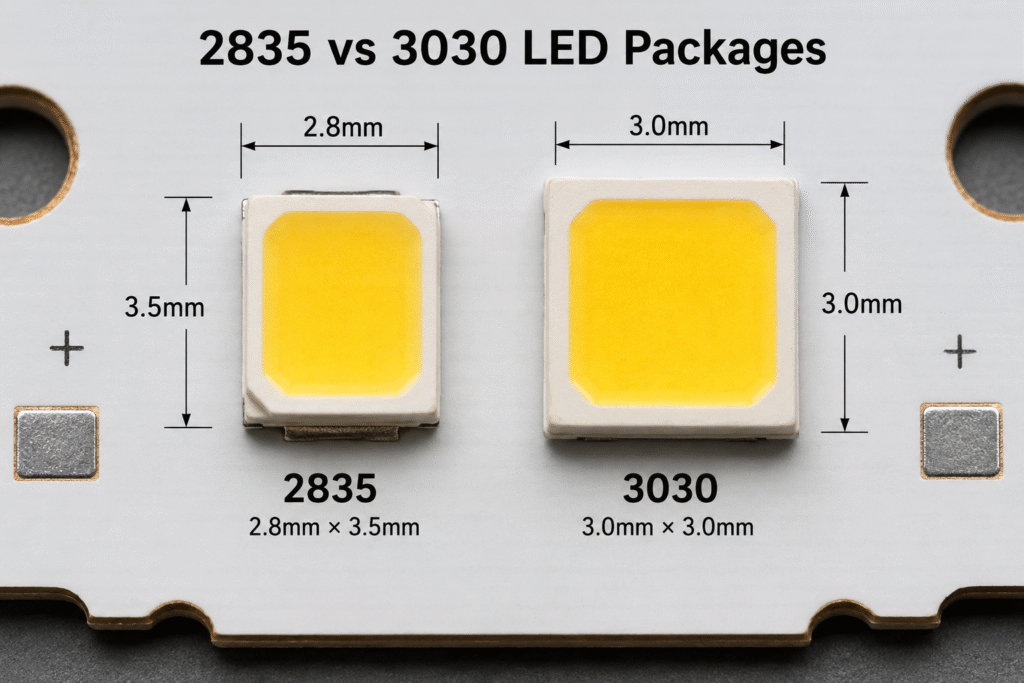
In reality, they simply describe the physical dimensions of the LED package.
| LED Package | Package Dimensions | Package Shape |
|---|---|---|
| 2835 | 2.8 × 3.5 mm | Rectangular |
| 3030 | 3.0 × 3.0 mm | Nearly square |
Although the difference looks small, it significantly affects how much semiconductor die can be placed inside the package.
A larger package generally allows:
- Larger LED chips
- Higher drive current
- Higher power handling
- Better heat spreading
- Higher maximum lumen output
Think of it like comparing two rooms.
A 2835 package is a compact room with limited space.
A 3030 package provides more usable area for larger chips and improved thermal paths.
This extra space is one of the reasons 3030 LEDs are commonly used in high-power commercial and industrial lighting.
Power and Brightness Comparison
One of the biggest differences between these two packages is how much power each LED can safely handle.
| Specification | 2835 LED | 3030 LED |
|---|---|---|
| Typical Power | 0.2–0.5 W | 0.5–1 W |
| Typical Drive Current | 30–150 mA | 150–350 mA |
| Typical Luminous Flux | Depends on manufacturer, current, CCT and CRI | Generally higher per package at comparable operating conditions |
| Power Handling | Low to medium | Medium to high |
| Typical Application | Decorative and low-to-medium-output lighting | Commercial, industrial and high-output lighting |
A single 3030 LED can often produce two to three times more light than one 2835 LED.
That means a luminaire requiring the same total lumen output may need:
- fewer LEDs
- fewer solder joints
- simpler PCB layouts
- lower assembly complexity
For commercial lighting, fewer components often translate into better long-term reliability.
Practical Tip
Don’t judge a fixture simply by counting LEDs.
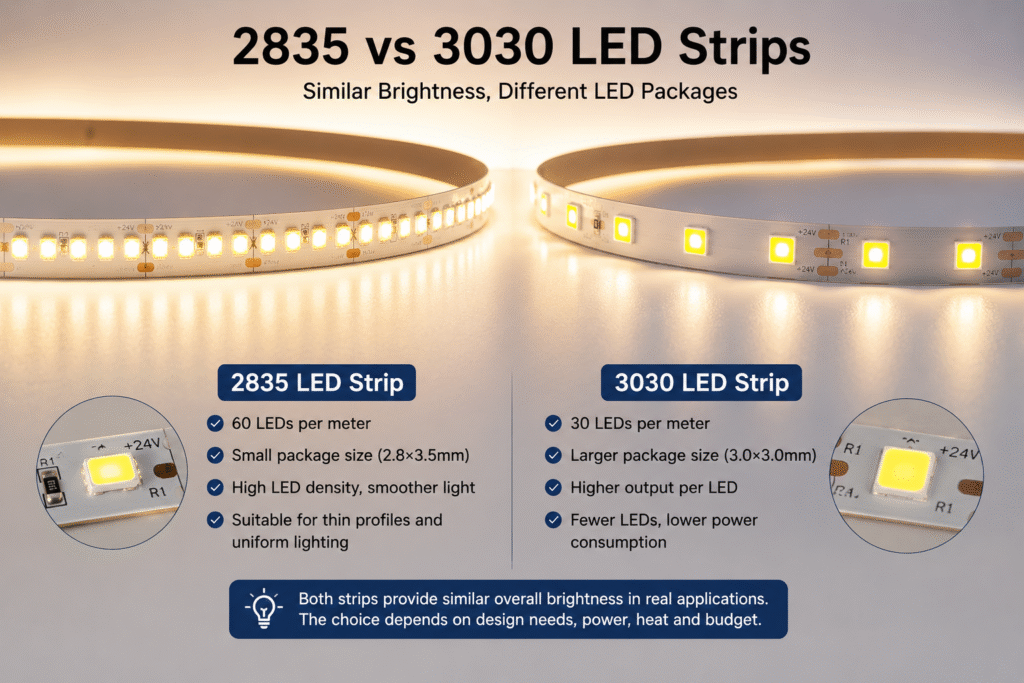
A strip with 60 pieces of 2835 LEDs may produce a similar lumen output to another strip using 30 pieces of 3030 LEDs.
The difference lies in long-term thermal performance and maintenance rather than the LED count.
Luminous Efficacy — Which One Is More Efficient?
Luminous efficacy measures how efficiently electrical power is converted into visible light.
It is expressed in lumens per watt (lm/W).
Typical performance today is:
| LED Package | Typical Efficacy Range | Performance Characteristics |
|---|---|---|
| 2835 LED | Approximately 100–180+ lm/W, depending on model and test conditions | Can achieve excellent efficacy when operated at a relatively low current |
| 3030 LED | Approximately 120–200+ lm/W, depending on model and test conditions | Typically maintains stronger performance at higher operating power |
At first glance, the difference doesn’t seem dramatic.
In fact, 2835 LEDs can sometimes achieve slightly higher efficacy at very low drive currents, because lower junction temperatures improve conversion efficiency.
However, commercial luminaires rarely operate under laboratory conditions.
Once current increases, thermal losses become much more significant.
This is where 3030 LEDs begin to outperform 2835 LEDs.
Because of their larger thermal path and superior package design, 3030 LEDs maintain higher efficacy under high-power operation, while 2835 LEDs experience a more noticeable efficiency drop.
Thermal Performance Is Where 3030 Really Wins
Heat is the biggest enemy of LEDs.
Lower operating temperature means:
- longer lifetime
- slower lumen depreciation
- better color stability
- higher reliability
One of the most important indicators is thermal resistance (°C/W).
| Specification | 2835 LED | 3030 LED |
|---|---|---|
| Typical Power Density | Lower | Higher |
| Heat Dissipation Capability | Suitable for low-to-medium-power operation | Generally better suited to higher-power operation |
| Common Package Materials | PPA, PCT or EMC, depending on product grade | Often EMC; ceramic options are also available in some product families |
| Thermal Design Requirement | Requires appropriate PCB and luminaire heat dissipation | Still requires appropriate MCPCB, housing and thermal interface design |
| Best Use | Moderate-output, cost-sensitive designs | High-output and long-operating-hour applications |
A lower thermal resistance means heat generated inside the LED chip can escape more quickly.
This keeps the junction temperature lower.
The packaging material also matters.
Many standard 2835 LEDs use PPA or PCT plastic packages, while premium 3030 LEDs often adopt EMC (Epoxy Molding Compound) or ceramic substrates that offer:
- higher heat resistance
- improved UV resistance
- lower thermal expansion
- better long-term stability
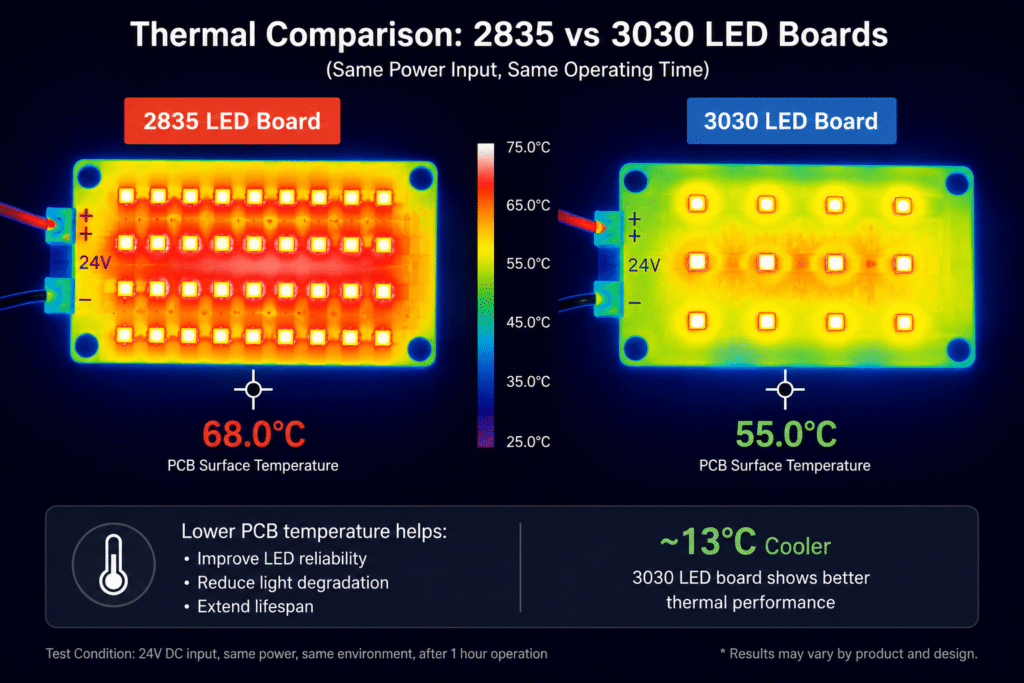
In practical testing under identical operating conditions, PCB temperatures using 3030 LEDs are often 10–15°C lower than comparable 2835 designs.
According to semiconductor reliability models, every 10°C reduction in junction temperature can approximately double the lifetime of electronic components, although actual improvement depends on the specific design and operating conditions.
Lumen Maintenance — Time Reveals the Difference
A new luminaire may look equally bright on Day One.
The real difference appears after thousands of operating hours.
According to LM-80 testing, typical lumen maintenance under an 85°C junction temperature is approximately:
This advantage comes largely from superior thermal management.
Lower junction temperatures slow down:
- phosphor degradation
- encapsulant aging
- package discoloration
- chip degradation
For residential lighting, the difference may not become noticeable for several years.
For commercial lighting operating 10–16 hours every day, the gap becomes increasingly obvious over the fixture’s service life.
Buying Tip
Always ask for an LM-80 test report.
Without LM-80 data, manufacturer lifetime claims are much harder to verify.
Why Does a 3030 LED Cost More?
| Cost Factor | How It Affects the Price |
|---|---|
| LED Die and Package Design | Some 3030 LEDs use larger dies, multiple dies or package structures designed for higher current and output. |
| Packaging Materials | Higher-grade EMC, silicone, lead-frame and phosphor materials can increase manufacturing cost. |
| Thermal Performance | Packages designed for lower thermal resistance and higher junction-temperature tolerance usually cost more. |
| Optical Binning | Tighter control of luminous flux, CCT, CRI and SDCM increases sorting and production costs. |
| Reliability Testing | Products supported by LM-80 data and more extensive reliability testing may carry a higher price. |
| Brand and Product Grade | A premium 2835 may cost more than a low-grade 3030, so package size alone does not determine price. |
Overall, a 3030 LED package typically costs 1.5 to 2 times as much as a comparable 2835 package.
But that doesn’t automatically make it the better choice.
When Should You Choose 2835?
2835 LEDs remain an excellent solution for many applications.
Typical examples include:
- Decorative lighting
- Cabinet lighting
- Cove lighting
- Ambient lighting
- Residential LED strips
- Low-power architectural lighting
These applications don’t require extremely high lumen output or continuous heavy-duty operation.
Using 3030 LEDs here may simply increase project cost without delivering proportional benefits.
When Is 3030 Worth the Extra Cost?
3030 LEDs excel in demanding environments where reliability and thermal performance matter.
Typical applications include:
- Industrial lighting
- Warehouse lighting
- Street lighting
- Parking garage lighting
- High-bay luminaires
- Commercial linear lighting
- Retail lighting
- Sports facilities
- Exhibition halls
In these projects, the higher initial cost is often offset by:
- fewer LEDs
- reduced maintenance
- slower lumen depreciation
- longer service life
- lower total cost of ownership
Quick Comparison Table
| Feature | 2835 LED | 3030 LED |
|---|---|---|
| Package Size | 2.8 × 3.5 mm | 3.0 × 3.0 mm |
| Typical Power Level | Low to medium | Medium to high |
| Output per Package | Usually lower | Usually higher |
| Low-Current Efficacy | Can be excellent | Can also be excellent |
| High-Power Performance | Depends strongly on package quality and thermal design | Generally better suited to higher-current operation |
| Number of LEDs Required | Usually more packages for the same total output | Usually fewer packages for the same total output |
| Light Distribution | More closely spaced light points can improve visual uniformity | Fewer, brighter light points may require greater attention to diffusion and spacing |
| Typical Cost | Generally lower | Generally higher for comparable product quality |
| Typical Applications | LED strips, cabinet lights, panel lights and decorative lighting | Street lights, industrial luminaires, floodlights and high-output commercial lighting |
| Selection Priority | Cost efficiency and light uniformity | Higher output per package and demanding operation |
Final Thoughts
A 3030 LED isn’t expensive simply because of its model number.
Its higher price reflects meaningful engineering advantages:
- larger semiconductor die
- better thermal management
- higher drive current capability
- higher sustained efficacy
- slower lumen depreciation
- longer operational life
That said, choosing the most expensive LED isn’t always the smartest decision.
If you’re designing decorative or residential lighting, a quality 2835 LED can deliver excellent performance at a lower cost.
But for commercial, industrial, or high-output applications where fixtures operate for thousands of hours every year, investing in 3030 LEDs often reduces maintenance costs and delivers a lower total cost of ownership over the product’s lifetime.
Ultimately, selecting the right LED package is about matching the technology to the application—not simply buying the most expensive option.
Frequently Asked Questions About 3030 vs. 2835 LEDs
Is a 3030 LED always better than a 2835 LED?
No. A 3030 LED is not automatically better simply because it can handle more power.
The correct choice depends on the required lumen output, LED spacing, optical design, operating temperature, fixture dimensions, budget and expected operating hours.
A high-quality 2835 LED operated at a conservative current may deliver excellent efficacy, uniformity and lumen maintenance. For decorative lighting, cabinet lighting, panel lights and low-to-medium-output linear luminaires, 2835 LEDs may provide a more economical and technically appropriate solution.
A 3030 LED becomes more valuable when the luminaire requires higher output per package, fewer LEDs, higher operating power or stronger long-term performance under demanding commercial and industrial conditions.
Which lasts longer, a 2835 LED or a 3030 LED?
The package number alone does not determine LED lifetime.
LED lifetime is influenced by:
- Junction temperature
- Drive current
- Package materials
- Phosphor and encapsulant quality
- MCPCB design
- Luminaire heat dissipation
- Driver quality
- Ambient temperature
- Operating hours
A well-designed 2835 luminaire can last longer than a poorly designed 3030 luminaire. However, a high-quality 3030 LED may provide better lumen maintenance in high-power applications because the package is often designed to manage higher current and thermal loads.
For a reliable comparison, review the specific LED datasheet, LM-80 report and TM-21 projection rather than relying only on the package name.
Why are 3030 LEDs commonly used in commercial and industrial lighting?
Commercial and industrial luminaires often require high lumen output, long daily operating hours and reliable performance at elevated temperatures.
3030 LEDs are commonly selected because they can offer:
- Higher output from each LED package
- Higher current capability
- Fewer LEDs for a given fixture lumen output
- Potentially fewer solder joints
- Compact high-output PCB layouts
- Strong performance in street lights, floodlights, industrial luminaires and outdoor fixtures
However, the final reliability of the luminaire still depends on the complete thermal, electrical and optical design.
Can a 2835 LED reach 200 lm/W?
Yes, some premium 2835 LEDs can reach or exceed 200 lm/W under specified test conditions.
However, luminous efficacy figures must be interpreted carefully. The result can vary according to:
- Drive current
- Junction temperature
- Color temperature
- CRI
- Forward voltage
- Test temperature
- Pulsed or continuous measurement conditions
An LED measured at a low current and 25°C may show a much higher efficacy than the same LED operating inside a sealed luminaire at a higher current and elevated temperature.
Therefore, the highest datasheet value should not be treated as the guaranteed efficacy of the complete fixture.
Can a 3030 LED reach more than 200 lm/W?
Yes. High-performance 3030 LEDs from established manufacturers may exceed 200 lm/W under particular test conditions.
As with 2835 LEDs, the actual luminaire efficacy will normally be lower after accounting for:
- Driver losses
- Optical losses
- Diffuser or lens transmission
- Thermal losses
- Wiring and PCB losses
- Real operating temperature
When evaluating a finished luminaire, compare the system efficacy in lumens per watt rather than only the LED package efficacy.
Which LED package is better for LED strips?
2835 LEDs are commonly used for LED strips because their compact shape supports close LED spacing, smooth light distribution and a broad range of power levels.
They are particularly suitable for:
- Cove lighting
- Cabinet lighting
- Display lighting
- Decorative linear lighting
- Continuous-light applications
3030 LEDs may be used when a strip requires higher output from fewer LEDs. However, the wider spacing between brighter light sources can create visible light spots unless the strip is combined with an appropriate diffuser, profile depth or optical design.
For LED strips, uniformity and thermal management can be more important than package size alone.
Does using fewer 3030 LEDs automatically reduce the failure rate?
Not necessarily.
Using fewer LEDs can reduce the number of solder joints and components, but each LED may operate at a higher power. This means a failure can affect a larger proportion of the total light output.
Reliability depends on the complete design, including:
- LED operating current
- PCB temperature
- Soldering quality
- Constant-current driver design
- Series and parallel circuit configuration
- Surge and overtemperature protection
Fewer LEDs can simplify the PCB, but it does not automatically guarantee a longer lifetime.
Is the light from 3030 LEDs more concentrated than light from 2835 LEDs?
The package name itself does not determine the final beam angle.
Light distribution depends on the LED package lens, reflector, secondary optic, diffuser, LED spacing and distance between the PCB and the optical cover.
A fixture using fewer high-output 3030 LEDs may show more visible light points than a fixture using a greater number of closely spaced 2835 LEDs. Designers may therefore need to increase the diffusion level, optical mixing distance or LED density to achieve a uniform illuminated surface.
Why can two 3030 LEDs have very different prices?
Not all 3030 LEDs have the same construction or performance.
The price may vary according to:
- LED brand
- Die size and number of dies
- EMC or ceramic package construction
- Luminous efficacy
- CRI
- SDCM tolerance
- Color consistency
- Forward-voltage binning
- Sulfur resistance
- Corrosion resistance
- LM-80 test data
- Warranty and traceability
A low-cost 3030 LED may perform worse than a premium 2835 LED. Buyers should compare the exact manufacturer, part number, datasheet and test documentation.
What should buyers check besides the LED package number?
The LED package should be only one part of the evaluation.
For a professional luminaire, buyers should also check:
- Initial fixture lumens
- System efficacy
- CRI and R9
- CCT and SDCM
- L80 or L90 lifetime
- LM-80 and TM-21 data
- LED brand and part number
- Driver brand and lifetime
- Junction and PCB temperature
- Ambient operating temperature
- IP and IK ratings
- Surge protection
- Dimming compatibility
- Warranty conditions
These specifications provide a more accurate picture of product quality than simply comparing “2835” with “3030.”
Should I ask the supplier for an LM-80 report?
Yes, particularly for commercial, industrial or project-based lighting.
LM-80 reports provide measured lumen-maintenance and color-shift data for LED packages or modules under specified temperatures and drive currents. TM-21 methodology can then be used to project long-term lumen maintenance from the LM-80 data.
However, an LM-80 report applies to the tested LED package under specified conditions. It does not independently prove that the complete luminaire will achieve the same lifetime. The fixture’s driver, heat dissipation, seals, optics and operating environment must also be considered.
Is 3030 worth the higher price?
3030 LEDs may be worth the additional cost when the application requires:
- High lumen output
- Long operating hours
- High ambient temperatures
- Compact PCB layouts
- Fewer LED packages
- Demanding commercial or industrial operation
- Lower long-term maintenance requirements
For low-output residential or decorative applications, a quality 2835 LED may already meet the project requirements at a lower cost.
The most suitable option is not necessarily the more expensive package. It is the package that delivers the required optical, thermal and lifetime performance at the lowest total system cost.
References
- Illuminating Engineering Society, ANSI/IES LM-80-21: Measuring Maintenance of Light Output Characteristics of Solid-State Light Sources. The standard measurement method used to evaluate luminous flux and color maintenance of LED packages, arrays and modules under specified operating conditions. View IES Standards
- Illuminating Engineering Society, ANSI/IES TM-21-21: Projecting Long-Term Luminous, Photon, and Radiant Flux Maintenance of LED Light Sources. Provides the methodology used to project long-term LED flux maintenance from LM-80 measurement data. View the IES TM-21 Calculator
- Illuminating Engineering Society, PS-10-18: IES Position on LED Product Lifetime Prediction. Explains that LM-80 and TM-21 evaluate LED components, while complete-luminaire reliability also depends on the driver, optics, thermal design and other components. Read the IES Position Statement
- Cree LED, J Series 2835 LED Product Portfolio. Manufacturer information covering 2835 LED package options, efficacy, color temperature, CRI, voltage and recommended lighting applications. View the 2835 LED Portfolio
- Cree LED, J Series 3030 LED Product Portfolio. Manufacturer information for high-reliability 3030 LEDs developed for high-efficacy lighting, outdoor applications and harsh indoor environments. View the 3030 LED Portfolio
- Cree LED, LED Product and Application Guide. Product-selection information covering LED package families, performance characteristics, operating conditions and application positioning. View the Product Guide